@thedarkfourth 's contributions in the Jan Feb 2016 story comp give me an opportunity to re-emphasise something: I consider myself to be an improving writer not an authority on writing. It helps me to analyse what I do so I can understand my processes - I can start to see why some things work, why some don't and which tried and tested tool to reach for next time. Since I want to collect all of my short pieces into one thread, and I'm going to think about it anyway, I'm doing a brain dump as I go. There is probably an element of selfishly wanting to justify my dodgy artistic choices, but mostly I want to encourage others to write (because I like to read - another selfish motive).
I want y'all to understand that these commentaries are a record of what I did and why, not a list of things that I think other people should do. Don't think about them too hard
To try and understand the mind of Bob is to look into a realm of madness
I'm going to do a triple analysis of The Naturalist, because it clearly illustrates a number of things I like to do.
Points of View
I generally write in third person from a single character's point of view. I might flip flop between character PoVs from section to section, but I generally have the person, that I call
the witness, who observes and interprets events.
The witness has access to their own knowledge and feelings, therefore I give my reader access to the same knowledge. To escape that coming from some godlike narrator, I try to have my witness thinking about knowledge they already have (thereby sharing the knowledge with my reader) or having another character tell the witness things the witness doesn't know.
I go to great lengths to avoid 3rd Person Omniscient PoV - to the extent that I have cut some 15000 words of well researched, well thought out and well written exposition out of The Great War Against Chaos. I also cut some scenes which were just too silly to slip through, or which broke the pace of the story Don’t worry – they are all there for the appendices.
I have also done complete rewrites of scenes because I later discovered that my preferred witness would not be available for other plot reasons.
Chapter 23 - Dungeon in
Scourge of the Empire was originally written with Bullenscheisse as the witness. I thought he would be busy with experimentation, so I rewrote it with the only other plausible character as witness – Wolf Priest Heimlich. It was OK, but I lost the wide eyed naivety of Bullenscheisse’s interaction with the cultist. 6 months later, I worked out how to reshuffle other story events to free up Bullenscheisse and then I wrote him back in.
I medium strongly disagree with both
@Scalenex and
@thedarkfourth on the concept of show, don't tell, because my witness cannot possibly see everything of relevance that has happened / is happening in the world - even if it happened on the same battle field. Even if they saw the same event.
This leads into
The Mystery of Bob
My plots are meant to be mysteries, to the extant that the witnesses (and by extension, my reader) won't usually have access to all of the facts that allow them to interpret their situation accurately - until I reveal some other detail which is meant to clarify what is really going on.
I reckon my short stories with twist endings rely on holding stuff back, or supplying ambiguous info that can be interpreted two ways and corralling my reader into one set of beliefs, then surprising them with a reverse. When my reader says “that’s an ass-pull’ and goes back to check the first half, she will find that all the clues were there, hidden in plain sight. Betcha didn’t know my reader was a gurl. (Daughter of Bob)
There are times when no existing character can possibly have knowledge which is vital to the plot. If stuck in this hole, one solution is to introduce another character and story arc which involves someone who was there. My best sample of using huge amounts of expository dialogue is
Chapter 15 - Nuln in
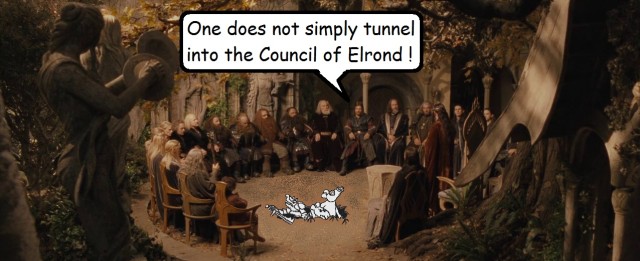
Scourge which is a lot shorter than the Council of Elrond. (The other way of dealing with impossible knowledge is to just refer to "the Prophecy". Just like every other piece of fantasy ever written.)
Your new character and witness-to-unseen-events can “Tell –not show” and then your main characters can drift further down the river of plot without needing another messy battle.
If you are going to tell – not show, you had better be good at writing expository dialogue, and put it in the middle of something else that is actually happening on screen. The Council of Elrond is an extreme example of all talk and no action – but we forgive it because, hey, Tolkien.
Boblogical Dialogue Monologue
One more point to make before I actually say something original - another problem with the witness exposition approach is that there are some important plot knowledge things that people would never talk about. For example, if all characters know that the Transformation of Kadon has certain effect, one wouldn't say to another "I should cast ToK, which you already know will turn me into whatever monster I have spare in my army case".
In real life, people who share knowledge talk in shorthand. The following excerpt is of the same characters and use of the same spell.
"Stomping time?"
"Do it."
Convincing dialogue? - yes. Helpful exposition? - not so much.
Bob's solution: have one character with knowledge and at least one without. It doesn't matter if the witness is the master or the pupil, or if two characters are knowledgeable about different things. (and team reunions are an efficient (and lazy) way to force feed nutritious exposition between slices of tasty dialogue.)
So... that is why I would select dialogue from my tool box to provide exposition. The bonus is that dialogue simultaneously establishes characters and relationships.
The
how of Bob writing the dialogue for the Naturalist was like this.
· Have a basic idea of the plot twist – actions and attitudes of the human characters are bizarrely mirrored by the lizards.
· Have a basic idea of what needs to be set up (What does the reader need to know so that the twist will be a surprise but make sense?)
· Have a basic idea of which characters will carry the plot. In this example, the academician has knowledge (which is innacurate) to share with my witness, the mercenary (who has better knowledge and better instincts - allowing me to contrast the personalities)
· Have a vague idea of the character personalities. The academician was to be arrogant, sarcastic and patronising. I also wanted him to be inhuman / cold blooded because the point of the plot twist was to make a parallel with his lizardman equivalent. The mercenary was to be insightful, efficient and pragmatic. If the characters are one dimensional at this point, that is fine. The process of writing their words helps to build them into solid characters with - my favourite word - integrity. Integrity means they are consistent in their attitudes and actions. The dwarf may tolerate the elf but there won't be hugs. The rat-thing may assist the man-thing but it will be for his own selfish gain.
· I wrote some cool lines of dialogue in no special order. The purpose of each line was either to provide background / exposition OR establish the nature of the speaker OR the relationship between characters.
· I put the lines into a logical order and imagined what the other character would do or say to prompt the next set of lines (eg asks a question).
· Cut out everything that doesn't work. These are lines I wrote for this story. I enjoyed writing them and I think they sound awesome. Then I mercilessly cut them out because I couldn't link the ideas efficiently or they needlessly reiterated info which came across better somewhere else.
o “You fear it? Science will reduce everything to its component parts. Then there will be nothing left to fear.”
o You should not say that there are things that cannot be explained, rather that there are things that have not yet been explained.”
o “Your tavern rats do not observe either. They see what they believe.”
o “I was hired to keep you alive” / “My survival is irrelevant. My knowledge must be preserved above all other considerations. Those parchments must be returned!”
· Insert stage directions and thought bubbles. Non verbals like "the cold one obsessively attacked the bars with no heed to its own safety" or "the single mindedness of the cold one reminded the mercenary that his employer was equally obsessed. He grimaced at the thought that he would soon be sharing a small ship with both of the cold blooded beauties." This is the place to show the reader what they need to see and how the characters feel about the situation. Treat your characters like actors and you are the director. Tell them to hop on one foot and bite their lip - make that stubbed toe look painful. Or tell them to scan the horizon even though it's just greenscreen anyway. It will link to the next camera shot.
· Insert things to make things better. Better means the ideas flow better, the theme or characterisation are reinforced, engaging little details are added. Mainz was probably always going to have spectacles, but the whole idea of them being stolen and used as bait was a late insertion. The plot was not altered, but the detail is amusing and it gives the character stronger motivation.
· Read it again. Do the characters speak and act with integrity? Do their speech patterns conform with their race, status and mood? Do all plot events have a logical cause and effect? No? Fix it.
· Extra work for Bob: I chose from the point of inspiration that the punchline would be a lizardman echoing the words of the lizard-like human. That meant I had to plan the dialogue, attitudes and societal roles together so that the same or similar words could be used by both with integrity. I think that making that effort made the end of the story way too slow, but hey, it got some votes. If I tried something similar in future, I would try to squish some more setup into the section before the point of view switch.
@thedarkfourth will tell me that the reversal of the scene without any lizard dialogue would have made the point clearly enough, but the problem is, I don’t trust my reader to pick everything up (she is only 13)
BONUS secret knowledge about dialogue!!!!
My definition of a plot hole is where the story develops in a way that would lead a reasonable reader to lift their head and ask a question.
Your characters can paper over massive plot holes through the use of
only 2 lines of dialogue:
Plot holes are not inherently bad. If they happen in a way that encourages the reader to use their imagination to fill in the blanks about some off screen event, this can be ok. For example, if character B was sent to secure the city gate, then he conveniently reappears during the main battle looking battered but alive, the reader can smoothly assume that the struggle for the gate has been won. Adding the lines “do not return to me until the gate is secured” to the set up make it a not-plot hole, but may make the earlier dialogue more clunky.
If the reader needs to break concentration to work something out, THAT is bad. Even worse is when the reader says "where the heck did those eagles come from? This is stupid."
But the very worst thing is when your very competent characters are in the middle of a huge ass-pull and they don't even notice.
Here is my recommendation: as you do your first proof read of your masterpiece, before you even worry about spelling the hero’s name three different ways or whatever, read it from the reader’s perspective. If you identify something that a reasonable anthropomorphic giant lizard might possibly ask a question about, get one of your characters to ask it first.
The weird thing is, the reader doesn't even need to receive a convincing (or any) answer to defuse the ticking plot bomb. The reader subconsciously says “yeah I spotted that plot hole, too. There might be an explanation coming that will stop me from needing to think too hard right now.” And then they move on.
The following example (with permission) is from Infinity Turtle’s short story,
Midnight Chase, which I had the pleasure of providing editorial assistance for.
Plot problem: There was no stated reason for why the daemon / daemons would be chasing the two random kids rather than continuing their killing spree.
Solution: These two lines of dialogue acknowledged the problem and provided a vague solution. I still don’t think it makes any sense, but my suggestions were all about 3 paragraphs long and way too metaphysical for this tight little action piece.
"Why is it chasing us?" Shalease asked, clinging to my hand.
"I don't know. Maybe it doesn't want to be seen. It wants no human witnesses…" I panted.
TL;DR It helps if you know and can express the reasons for continuity jumps in your stories. If you actually don't know or don't care, just copy and paste these two lines somewhere into your dialogue:
"What the Old Ones just happened?"
"How the Mahrlect am I supposed to know?"