
Slann
Scalenex
Keeper of the Indexes
- Messages
- 11,493
- Likes Received
- 20,440
- Trophy Points
- 113
Lets Talk Temples!
I covered Taboos and Lizardmen defensive structures to set the groundwork for two more posts. One covers temple cities, and one covers temple cities. I figured I’d cover the religious aspects first because Lizardmen are a theocracy and religion and magic comes first in all things.
Lizardmen live in Temple Cities, but relatively little attention is given to temples. Time to fix that with a really really long fluff thread!
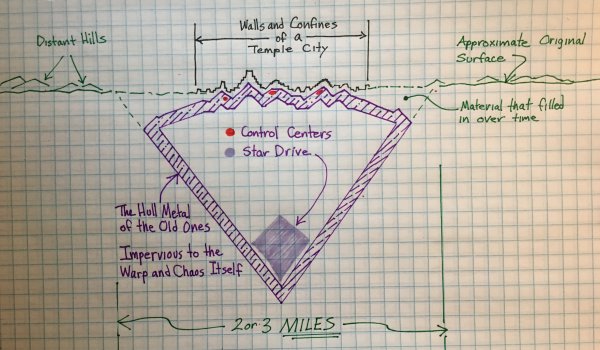
I’m going to reference the temple here fairly often. I’m not sure I like these diagrams from the 5th edition army book but they provide a baseline for discussion. I’m also going to use temple and pyramid pretty interchangeable.
What are real temples for?
In the real world, generally temples are either holy sites or places of worship. Probably both. Do the Lizardmen consider their pyramids holy? Certainly! Do they worship there? That’s up for debate. We’ll put a pin in that for now.
Functions of a Lizardmen Temple
But Lizardmen temples are used for so much more than sites of worship or holy objects of admiration.
Slann live in temples. This makes temples like palaces/mansions for the rulers. This also means the pyramids are governing centers. Even if the Slann are asleep it’s likely the Skink and Saurus leaders make the bulk of the big plans and strategies from within temple chambers just out of habit.
Lizardmen pyramids usually have secure vaults with diligent guards and potent magical protections for holy items. This can blur the line for what is holy, the temple or the temple’s contents, but that distinction matters little. Holy is holy.
Sometimes they might safely store profane artifacts in similar vaults to keep them from causing damage.
Deceased Slann are mummified and stored in similar vaults, making Lizardmen pyramid temples similar to the temple tombs of real world Ancient Egypt.
Slann can use pyramids to augment the range and power of their telepathy. They can enhance their scrying abilities, and they channel greater magic powers easier. Skink Priests may be able to tap into a fraction of this power too.
Some fluff sources have Saurus spawning pools located underground beneath some temples.
That’s it.
I’m not going to say it.
……Lizardmen temples serve as emergency spaceships. Are you happy now!
Do Lizardmen worship in their pyramid temples?
In the modern world, a place of worship probably has locks on the doors and other basic security measures, for when it’s not in use, but ultimately, regardless of what religion a place of worship is dedicated to, the place of worship is probably designed the building easily accessible to the faithful.
Slann live in these pyramids. The more accessible you make a Temple, the more vulnerable the Slann is. Also, the more accessible a temple is, the more vulnerable the temple vaults are. True, a visiting congregation of Skinks and Kroxigor would probably never harm a Slann or steal an artifact. True, it would be very difficult for an enemy of the Lizardmen to infiltrate the Skinks and Kroxigor, but having a wide public entrance is still a point of entry for assassins, thieves, and spies.
In addition to direct dangers to Slann, Lizardmen tend to walk on egg shells around a Slann that is meditating or contemplating. Crowds of worshipers tromping in and out singing hymns “Sotek loves me yes I know, cause he makes the rat blood flow” could interrupt a Slann’s concentration or the Slann’s Skink attendants could think this might bother the Slann which would have the same effect on their behavior.
True, a lot of nations have public tours of their government buildings but these are generally limited and carefully proscribed, so one could mix a need to allow worship with a Slann’s need for privacy and time, but what about the temple vaults? There are no public tours of Fort Knox and probably never will be.
There is another difficulty with Lizardmen using their pyramids as places of worship, and that is space. A pyramid is not the world’s most efficient storage shape, and if real world architectural limitations and the diagram from the 5th edition book are any indication, pyramids are not perfectly empty and hollow with several well composed floors. That’s not a lot of space to begin with and you already have to cut off any areas taken up for sacred vaults or Slann quarters. That’s not a lot of space to accommodate large crowds of worshippers.
This setup can work if Lizardmen take short breaks from their day and head to the temple alone or in small groups, make simple prayers, maybe talk to a Skink priest for advice, then leave and return to their duties. As long as the stream of worshippers is staggered this will work fine, but all indications are that Lizardmen are a communal society. Their natural inclination is to work, fight, eat and sleep in large groups. They would probably want to worship in large groups as well. Worship can certainly be a community builder.
Based on the above things I said, I do not believe most Lizardmen would use their most sacred pyramids as a place of worship. What options are there?
Option 1: The above assertion is wrong. Since Lizardmen are a theocratic society they don’t need to worship in large groups because they already know what they are doing and why. They only need small worship spaces with limited access because a typical Lizard rarely needs to worship in a temple.
Option 2: The Lizardmen have two main types of temples, private temples and public temples. The first type is the aforementioned magic temple that augments a Slann’s power, serves as a Slann quarters, and is used to store sacred treasures in secure vaults. The second type of temple is still sacred, but it is not heavily guarded. They are designed to maximize usable space. They are built around accessibility rather than accessing fonts of magical power. Private temples are used by the Slann, public temples are used by everyone else.
Option 3: Temples are sacred holy places, but most worship is done elsewhere. Maybe worship is done outside in courtyards or fields. Maybe they worship in open air buildings designed to maximize capacity like amphitheaters and coliseums. Worship areas could either be in the literal shadow of the temples or they could be located near the densest populated portions of the city for ease of access. Alternatively they can be located in the most empty unused spots of the city so the daily working of the city doesn’t interfere with worship. If most of a Temple City’s space is occupied, then spaces set for worship would be any spaces left open. This is currently my favorite option. So far, when I had large gatherings in my own fluff pieces, I assumed they’d be in a coliseum-like structure. I haven’t figured out where they are located in cities though. Whether they are in the shadow of a mighty temple, in a busy area, or on the outskirts.
Option 4: Something other people come up with.
Anyway where do you think most Lizardmen worship? This is part of this posting that I would especially appreciate feedback on.
Where are Temples Located?
Ha ha.
That doesn’t narrow it down that much. Both for writing fluff pieces and drawing maps, I want to know where to put temples. I am working on another detailed fluff thread on how a Temple City is built and how they get their basic needs, food, water, sanitation, etc. I cannot really do that till I figure out where the temples go, since I’m betting temples come first, they get first dibs on space and the support infrastructure has to conform to the temples, not the other way around.
Also, given that Temple Cities change over time, I want to know if temples can be torn down and rebuilt without offending the Old Ones. Look at the link above again for the map of Itza. The very center of the city is a large Sotek Temple. In a way that makes sense because Sotek is the most important contemporary god in Lizardmen society. Still, Sotek is the Lizardmen’s youngest god and Itza is the Lizardmen’s oldest city. The big Temple of Sotek was clearly not there when the city was young. Either the Lizardmen tore down and rebuilt their city center or at the very least they re-purposed their central Temple for Someone Else into a Temple for Sotek.
I’m sure the official GW writers never leave gaping plot holes or logical inconsistencies, so this implies that, yes, temples can be taken down, moved, rebuilt, re-purposed and whatnot without offending the Lizardmen’s sensibilities too much. Alternatively they are just bad writers and we should toss out the map as an authoritative reference material. Maybe temples cannot be refurbished or moved.
These are the considerations as to where to put a temple, in an order that may or may not mirror their actual importance.
Temples need to be able to harness magical power
The 5th edition army book map of Itza may or may not be “canon”, but the map on page 25 of the 8th edition army book probably qualifies as canon. It’s certainly the most complete Lustrian map ever published. The major Temple Cities and monuments are built along geometrically perfect ley lines and their intersections.
Lizardmen temples, at least the ones used as magical conduits, need to be able to access these ley lines. It’s up to individual interpretation just how nitpicky these ley lines are. If you only need to be within a mile or perhaps even farther, then you can put the temples almost anywhere in a temple city and still let the Slann access the power. What if the ley lines are almost literal lines as in very thin lines? In order to access these ley lines the exact center of every temple needs to be precisely over a very precise point. That means Temples would be grouped together in a perfect straight line. If the Temple City is an intersection of ley lines, the layout of temples would looks like an X.
That’s assuming the ley lines look like they do on the map. It could be the case that the major ley lines look like the perfect diamonds and 90 degree intersection points on the macro level, but once you go to the local level, the lesser ley lines go in different directions. If the ley lines are not finicky, this doesn’t matter. If the ley lines are finicky this means temples have to be centered in exact specific points, but they wouldn’t necessary be in straight lines. Still, even if it’s not a straight line, the patterns should makes sense to the eye, geometrically speaking. The ley lines and temples are still intended to shore up Order against Chaos, so they should probably make recongizeable shapes, not take the form of random squiggly lines.
Of all the aspects of temples, this is the one I am least sure of and would like to mine the minds of the forumites for ideas. If the ley lines are finicky then pretty much none of the considerations that follow will be taken into consideration since the ley lines come first unless you are using the interpretations that Lizardmen have public and private temples, then the private temples certainly must be built a long ley lines and the public temples do not have to be (thought they might be just out of tradition).
Temples need to be accessible to those who use them
If it’s just the Slann and their Skink attendants using the Temples, they can be almost anywhere. They are accessible to the users because the users live there. Assuming the unwashed masses need to use a temple for broad worship, the ideal place would be along major paved crossroads or near the big clusters of Skink barrios. If a temple is mainly used for a specific purpose, it should be located accordingly.
Ideally a Temple of Itzl would be located somewhere near the beast pens because the beast handlers are going to offer more prayers than the general population. “Great and Wise Itzl, please do not let my Salamander eat me”
A Sotek temple, at least one that regularly offers mass sacrifices, may not actually work best in the city center. Skinks literally take their enemies here. Do you want to take potentially plague bearing enemies into the heart of your city? Probably not.
Potec is a god of supernatural protection. Tepoc is a god of magic in a general sense. If only a few temples need to be built directly on the ley lines, these are the two temples would be on the shortlist, though you can come up with other justifications. Since Potec is a god of protection, his temples might be built on the edge of the city as sort of a barrier against external corruption, just for perceived utility, this segues into the next part.
Temple locations may have to do with folklore and superstition.
This kind of related to ley lines and this is kind of related to accessibility. Superstitions can help figure out where temples should be. I like the idea of Huanchi the night god having temples in the west towards the setting sun and Chotec the sun god having temples in the east towards the rising sun. That leaves a lot open to interpretation. You could have a single temple in the city center with one Temple that’s eastern half is dedicated to Chotec and the western half is dedicated to Huanchi. Or if the temples are clustered in a district, Chotec and Huanchi can bookend the east and west sides of the temple district. Alternatively you could have Temples to Chotec and Huanchi on the far east and far west sides of the city.
Warriors would want the blessing of Sotek and the Old Ones dedicated to war. They would probably appreciate it if these temples were located near their barracks, training fields, and/or watch towers if possible so the gods can bless their martial endeavors. It would probably be considered lucky to have a temple of Tzunki overlook the city’s spawning pools or Tzunki’s temple could be symbolically guarding a city’s primary source of drinking water. Temples could be built on the site of great victories and horrible defeats to honor and memorialize the deaths of heroes. There are near limitless possibilities for superstition based Temple placement.
There is an interesting dissonance here. Superstition could lead Lizardmen to want to relocate a temple to a more favorable place often as circumstances and histories change. Superstition could also lead Lizardmen to never want to relocate a temple for any reason because moving a temple would be insulting to the gods.
Temple should ideally be located in defensible locations
I discussed Lizardmen defensive strategies here.
Long story short, there is nothing that the Lizardmen want to defend more than their temples and spawning pools. Apart from the Skaven and the rare forward thinking Daemon, most enemies of the Lizardmen are not going to bother poisoning spawning pools, spawning pools have nothing to steal and most warmblood invader are not aware that future generations of Lizardmen come out of them. The general consensus is that spawning pools cannot be moved or replaced. It is possible that Temples can be moved or replaced.
So if Lizardmen have the option of moving their temples, and if they have the freedom to put them wherever they want. From purely strategic perspective, the best place to put a Temple City’s temples is in the very center of the city. That way invaders have to fight through the entire city to get to the temples. Also it is easier to defend one strategic objective instead of seventeen scattered temples. If a city’s temples are widely scattered, basically a Temple city has no second line of defense, if the outskirts of a city is breached by the enemy, it will be difficult to defend every temple. Though if you have public and private temples, the public temples can be abandoned to the enemy in dire situations.
Even if a Temple City or Kahoun doesn’t have the resources to build and maintain full city walls, Lizardmen would be fools to not have an interior wall around their temple district if the Temples are tightly clustered together. If they do have walls around the whole city, they can probably spare the resources to make a secondary wall around the temple district, if there is a temple district. That’s a fantastic second line of defense.
Spawning pools and temples fit together
The one diagram we have a Lizardmen pyramid temple has a Saurus spawning pool beneath it. Officially, Saurus spawning pools are located underground. Skink and Kroxigor spawning pools are located above ground. There is an appeal to placing temples on top of Saurus spawning pools and there is an appeal in placing temples adjacent to Skink and Kroxigor spawning pools.
The appeal to place spawning pools with temples is two-fold, maybe three if spawning pools are found along mystic ley lines. There is a superstitious benefit, its good fortune to have a spawning of Skinks or Saurus under the eye of the Old Ones. It might be especially appealing to place temples to war gods near Saurus Spawning pools for instance.
There is a strategic benefit to clustering temples near spawning pools too. Since the two most important things to defend in a city are the spawning pools and temples, defense because slightly easier if these two resources can be defended together.
All that said, a spawning pool can operate just fine independent of a temple and a temple can operate just fine independent of a spawning pool.
Sigh
Does the Fact that Some Temples are Spaceships Impact where they should be placed and whether or not they can be moved?
My answer to that is probably not. I don’t think it will impact where and how a temple is physically placed and whether it can be rebuilt.
Don’t tell me you can’t move a temple because it’s a spaceship. Spaceships by definition, can move. For all its pretensions to being a spaceship, most temples were assembled by Kroxigor stacking bricks at a Skinks direction. These structures are probably not air tight and able to withstand the vacuum of space (though maybe space is not a vacuum in the Warhammer Fantasy/Age of Sigmar universe). Magic, not craftsmanship, is what let the temples fly into space during the End Times. Presumably some combination of Slann spells and ancient artifacts of the Old Ones powered this magic. Slann and ancient artifacts can be moved. Therefore the temples they are attached to can also be moved as long as you move the sacred artifact and Slann with it.
My conclusion (feel free to dispute this): unless temples must be built physically on ley lines, they can be moved, but the potentiality or lack of potentiality of space travel will not affect whether a temple can be moved or replaced.
Anyway these are my thoughts. What considerations do you all think are the most important in determining where temples are physically placed? Do you think temples can be moved, repurposed or modified without offending Lizardmen sensibilities?
Besides City Temples, what other structures do Lizardmen consider holy or an aid to worship?
Again I’m not a big fan of this map of Itza, but it is a reasonable starting off point.
Maybe the map is not to scale but the four avenue of Lizard sphinxes are REALLY wide. The rules are often different for Lizardmen versus humans but the general rule for ancient and medieval human cities is lots of narrow cramped and often winding streets.
For day-to-day activities, it is probably a waste of space to have long wide streets that are wider than is necessary for a single loaded Stegadon to tromp down. The avenues on the map are MUCH wider. Since there is no practical purpose to have streets this wide, if you hold the map as canon, the avenues need a religious or mystical purpose.
I mentioned Lizardmen could use wide open spaces for religious ceremonies and observances, I guess this fits the bill. If religious observances take place along these wide avenue that means most major religious ceremonies would take the form of a parades or processions. Since the avenues move in four cardinal directions you could have Old Ones attributed to the North, South, East, and West. Alternatively a single god could have four aspects to his existence. I’m not a big fan of the four wide avenues approach to city design, but I can see the merits in it.
Ignoring the fact that the dictionary definition of a sphinx is a lion with a human head, and Lizardmen statues would not involve lions or humans. So sphinx is not the right nomenclature. But "quadrupedal statues with mismatched heads" doesn’t roll off the tongue. I’m not sure what their bodies would be, but probably not lions. I don’t know what their heads would be but probably not humans. I’m not sure what they would look like. I’m open to people posting pictures of drawing or terrain pieces. Unless someone comes up with a compelling pro-sphinx argument, sphinxes are not on my to-do list for terrain pieces to make. I like pylons, obelisks, cairns, and vertically oriented statues, but I don’t care for sphinxes, apart from Egyptian style sphinxs for Nehekaran themed terrain setups.
Another possibility I want to cover is temples and shrines outside of Temple cities. I doubt they are going to have Slann live in the deep jungle or stow sacred artifacts in the middle of nowhere, but the Lizardmen could maintain isolated temples in the wilderness. Probably near crossroads, water sources and other locations patrols are likely to visit. A Skink in the deep jungle probably has more things to pray about than one in a big city.
Caxautn is associated with deep jungle predators. I imagine it would be hard to properly worship in him in a city. A lot of Old Ones could have rites that require the wilderness to be authentic so the deep jungle could have some small temples and shrines. A great excuse to set up a battlefield terrain board with one Temple on it for simplicity.
Altars of Sotek are another religious structure that doesn't have to be in a city. The logistics of moving live prisoners through a track of jungle is difficult at best, dangerous at worst. First off, Lizardmen with prisoners are easier to track and move slower so if the Sotek sacrifice victims have friends, they know where to find the Lizardmen and can follow the trail to figure out which direct the temple city is. The longer it takes to move prisoners the greater chances of a rescue or escape attempt. Then there is the possibility that Skaven could be witting or unwitting typhoid Marys that they wanted to get caught. They did this to the Dark Elves. That's why Dark Elves don't take Skaven slaves anymore and they enslave EVERYONE. The sooner one can dispose of Skaven prisoners the better. Locating Altars of Sotek around the jungle is one way to help accommodate this.
On the road, I think large Lizardmen army would carry mobile shrines or icons. Similar to what Lizardmen standards look like but probably bigger carried back with the supply train...the invisible supply train that never sees the tabletop. I can imagine during religious ceremonies on campaign away from the cities that unit standards would be arrayed around the mobile shrine. If the army really has to travel light then can use their unit standards as the central icons to do their religious ceremonies.
More or what religious ceremonies look like in part two!
I covered Taboos and Lizardmen defensive structures to set the groundwork for two more posts. One covers temple cities, and one covers temple cities. I figured I’d cover the religious aspects first because Lizardmen are a theocracy and religion and magic comes first in all things.
Lizardmen live in Temple Cities, but relatively little attention is given to temples. Time to fix that with a really really long fluff thread!
I’m going to reference the temple here fairly often. I’m not sure I like these diagrams from the 5th edition army book but they provide a baseline for discussion. I’m also going to use temple and pyramid pretty interchangeable.
What are real temples for?
In the real world, generally temples are either holy sites or places of worship. Probably both. Do the Lizardmen consider their pyramids holy? Certainly! Do they worship there? That’s up for debate. We’ll put a pin in that for now.
Functions of a Lizardmen Temple
But Lizardmen temples are used for so much more than sites of worship or holy objects of admiration.
Astute Reader said:Of course!
Slann live in temples. This makes temples like palaces/mansions for the rulers. This also means the pyramids are governing centers. Even if the Slann are asleep it’s likely the Skink and Saurus leaders make the bulk of the big plans and strategies from within temple chambers just out of habit.
Astute Reader said:Lustria-Online’s predecessor was called the Pyramid Vault.
Lizardmen pyramids usually have secure vaults with diligent guards and potent magical protections for holy items. This can blur the line for what is holy, the temple or the temple’s contents, but that distinction matters little. Holy is holy.
Astute Reader said:You missed something obvious.
Sometimes they might safely store profane artifacts in similar vaults to keep them from causing damage.
Astute Reader said:Yes, but this was not what I was thinking.
Deceased Slann are mummified and stored in similar vaults, making Lizardmen pyramid temples similar to the temple tombs of real world Ancient Egypt.
Astute Reader said:You missed something magical.
Slann can use pyramids to augment the range and power of their telepathy. They can enhance their scrying abilities, and they channel greater magic powers easier. Skink Priests may be able to tap into a fraction of this power too.
Astute Reader said:And?
Some fluff sources have Saurus spawning pools located underground beneath some temples.
Astute Reader said:And?!?
That’s it.
Astute Reader said:You know what I am talking about…
I’m not going to say it.
Astute Reader said:DO IT!
……Lizardmen temples serve as emergency spaceships. Are you happy now!
Do Lizardmen worship in their pyramid temples?
In the modern world, a place of worship probably has locks on the doors and other basic security measures, for when it’s not in use, but ultimately, regardless of what religion a place of worship is dedicated to, the place of worship is probably designed the building easily accessible to the faithful.
Slann live in these pyramids. The more accessible you make a Temple, the more vulnerable the Slann is. Also, the more accessible a temple is, the more vulnerable the temple vaults are. True, a visiting congregation of Skinks and Kroxigor would probably never harm a Slann or steal an artifact. True, it would be very difficult for an enemy of the Lizardmen to infiltrate the Skinks and Kroxigor, but having a wide public entrance is still a point of entry for assassins, thieves, and spies.
In addition to direct dangers to Slann, Lizardmen tend to walk on egg shells around a Slann that is meditating or contemplating. Crowds of worshipers tromping in and out singing hymns “Sotek loves me yes I know, cause he makes the rat blood flow” could interrupt a Slann’s concentration or the Slann’s Skink attendants could think this might bother the Slann which would have the same effect on their behavior.
True, a lot of nations have public tours of their government buildings but these are generally limited and carefully proscribed, so one could mix a need to allow worship with a Slann’s need for privacy and time, but what about the temple vaults? There are no public tours of Fort Knox and probably never will be.
There is another difficulty with Lizardmen using their pyramids as places of worship, and that is space. A pyramid is not the world’s most efficient storage shape, and if real world architectural limitations and the diagram from the 5th edition book are any indication, pyramids are not perfectly empty and hollow with several well composed floors. That’s not a lot of space to begin with and you already have to cut off any areas taken up for sacred vaults or Slann quarters. That’s not a lot of space to accommodate large crowds of worshippers.
This setup can work if Lizardmen take short breaks from their day and head to the temple alone or in small groups, make simple prayers, maybe talk to a Skink priest for advice, then leave and return to their duties. As long as the stream of worshippers is staggered this will work fine, but all indications are that Lizardmen are a communal society. Their natural inclination is to work, fight, eat and sleep in large groups. They would probably want to worship in large groups as well. Worship can certainly be a community builder.
Based on the above things I said, I do not believe most Lizardmen would use their most sacred pyramids as a place of worship. What options are there?
Option 1: The above assertion is wrong. Since Lizardmen are a theocratic society they don’t need to worship in large groups because they already know what they are doing and why. They only need small worship spaces with limited access because a typical Lizard rarely needs to worship in a temple.
Option 2: The Lizardmen have two main types of temples, private temples and public temples. The first type is the aforementioned magic temple that augments a Slann’s power, serves as a Slann quarters, and is used to store sacred treasures in secure vaults. The second type of temple is still sacred, but it is not heavily guarded. They are designed to maximize usable space. They are built around accessibility rather than accessing fonts of magical power. Private temples are used by the Slann, public temples are used by everyone else.
Option 3: Temples are sacred holy places, but most worship is done elsewhere. Maybe worship is done outside in courtyards or fields. Maybe they worship in open air buildings designed to maximize capacity like amphitheaters and coliseums. Worship areas could either be in the literal shadow of the temples or they could be located near the densest populated portions of the city for ease of access. Alternatively they can be located in the most empty unused spots of the city so the daily working of the city doesn’t interfere with worship. If most of a Temple City’s space is occupied, then spaces set for worship would be any spaces left open. This is currently my favorite option. So far, when I had large gatherings in my own fluff pieces, I assumed they’d be in a coliseum-like structure. I haven’t figured out where they are located in cities though. Whether they are in the shadow of a mighty temple, in a busy area, or on the outskirts.
Option 4: Something other people come up with.
Anyway where do you think most Lizardmen worship? This is part of this posting that I would especially appreciate feedback on.
Where are Temples Located?
Stater of the Obvious said:In Temple Cities, DUH!
Ha ha.
That doesn’t narrow it down that much. Both for writing fluff pieces and drawing maps, I want to know where to put temples. I am working on another detailed fluff thread on how a Temple City is built and how they get their basic needs, food, water, sanitation, etc. I cannot really do that till I figure out where the temples go, since I’m betting temples come first, they get first dibs on space and the support infrastructure has to conform to the temples, not the other way around.
Also, given that Temple Cities change over time, I want to know if temples can be torn down and rebuilt without offending the Old Ones. Look at the link above again for the map of Itza. The very center of the city is a large Sotek Temple. In a way that makes sense because Sotek is the most important contemporary god in Lizardmen society. Still, Sotek is the Lizardmen’s youngest god and Itza is the Lizardmen’s oldest city. The big Temple of Sotek was clearly not there when the city was young. Either the Lizardmen tore down and rebuilt their city center or at the very least they re-purposed their central Temple for Someone Else into a Temple for Sotek.
I’m sure the official GW writers never leave gaping plot holes or logical inconsistencies, so this implies that, yes, temples can be taken down, moved, rebuilt, re-purposed and whatnot without offending the Lizardmen’s sensibilities too much. Alternatively they are just bad writers and we should toss out the map as an authoritative reference material. Maybe temples cannot be refurbished or moved.
These are the considerations as to where to put a temple, in an order that may or may not mirror their actual importance.
Temples need to be able to harness magical power
The 5th edition army book map of Itza may or may not be “canon”, but the map on page 25 of the 8th edition army book probably qualifies as canon. It’s certainly the most complete Lustrian map ever published. The major Temple Cities and monuments are built along geometrically perfect ley lines and their intersections.
Lizardmen temples, at least the ones used as magical conduits, need to be able to access these ley lines. It’s up to individual interpretation just how nitpicky these ley lines are. If you only need to be within a mile or perhaps even farther, then you can put the temples almost anywhere in a temple city and still let the Slann access the power. What if the ley lines are almost literal lines as in very thin lines? In order to access these ley lines the exact center of every temple needs to be precisely over a very precise point. That means Temples would be grouped together in a perfect straight line. If the Temple City is an intersection of ley lines, the layout of temples would looks like an X.
That’s assuming the ley lines look like they do on the map. It could be the case that the major ley lines look like the perfect diamonds and 90 degree intersection points on the macro level, but once you go to the local level, the lesser ley lines go in different directions. If the ley lines are not finicky, this doesn’t matter. If the ley lines are finicky this means temples have to be centered in exact specific points, but they wouldn’t necessary be in straight lines. Still, even if it’s not a straight line, the patterns should makes sense to the eye, geometrically speaking. The ley lines and temples are still intended to shore up Order against Chaos, so they should probably make recongizeable shapes, not take the form of random squiggly lines.
Of all the aspects of temples, this is the one I am least sure of and would like to mine the minds of the forumites for ideas. If the ley lines are finicky then pretty much none of the considerations that follow will be taken into consideration since the ley lines come first unless you are using the interpretations that Lizardmen have public and private temples, then the private temples certainly must be built a long ley lines and the public temples do not have to be (thought they might be just out of tradition).
Temples need to be accessible to those who use them
If it’s just the Slann and their Skink attendants using the Temples, they can be almost anywhere. They are accessible to the users because the users live there. Assuming the unwashed masses need to use a temple for broad worship, the ideal place would be along major paved crossroads or near the big clusters of Skink barrios. If a temple is mainly used for a specific purpose, it should be located accordingly.
Ideally a Temple of Itzl would be located somewhere near the beast pens because the beast handlers are going to offer more prayers than the general population. “Great and Wise Itzl, please do not let my Salamander eat me”
A Sotek temple, at least one that regularly offers mass sacrifices, may not actually work best in the city center. Skinks literally take their enemies here. Do you want to take potentially plague bearing enemies into the heart of your city? Probably not.
Potec is a god of supernatural protection. Tepoc is a god of magic in a general sense. If only a few temples need to be built directly on the ley lines, these are the two temples would be on the shortlist, though you can come up with other justifications. Since Potec is a god of protection, his temples might be built on the edge of the city as sort of a barrier against external corruption, just for perceived utility, this segues into the next part.
Temple locations may have to do with folklore and superstition.
This kind of related to ley lines and this is kind of related to accessibility. Superstitions can help figure out where temples should be. I like the idea of Huanchi the night god having temples in the west towards the setting sun and Chotec the sun god having temples in the east towards the rising sun. That leaves a lot open to interpretation. You could have a single temple in the city center with one Temple that’s eastern half is dedicated to Chotec and the western half is dedicated to Huanchi. Or if the temples are clustered in a district, Chotec and Huanchi can bookend the east and west sides of the temple district. Alternatively you could have Temples to Chotec and Huanchi on the far east and far west sides of the city.
Warriors would want the blessing of Sotek and the Old Ones dedicated to war. They would probably appreciate it if these temples were located near their barracks, training fields, and/or watch towers if possible so the gods can bless their martial endeavors. It would probably be considered lucky to have a temple of Tzunki overlook the city’s spawning pools or Tzunki’s temple could be symbolically guarding a city’s primary source of drinking water. Temples could be built on the site of great victories and horrible defeats to honor and memorialize the deaths of heroes. There are near limitless possibilities for superstition based Temple placement.
There is an interesting dissonance here. Superstition could lead Lizardmen to want to relocate a temple to a more favorable place often as circumstances and histories change. Superstition could also lead Lizardmen to never want to relocate a temple for any reason because moving a temple would be insulting to the gods.
Temple should ideally be located in defensible locations
I discussed Lizardmen defensive strategies here.
Long story short, there is nothing that the Lizardmen want to defend more than their temples and spawning pools. Apart from the Skaven and the rare forward thinking Daemon, most enemies of the Lizardmen are not going to bother poisoning spawning pools, spawning pools have nothing to steal and most warmblood invader are not aware that future generations of Lizardmen come out of them. The general consensus is that spawning pools cannot be moved or replaced. It is possible that Temples can be moved or replaced.
So if Lizardmen have the option of moving their temples, and if they have the freedom to put them wherever they want. From purely strategic perspective, the best place to put a Temple City’s temples is in the very center of the city. That way invaders have to fight through the entire city to get to the temples. Also it is easier to defend one strategic objective instead of seventeen scattered temples. If a city’s temples are widely scattered, basically a Temple city has no second line of defense, if the outskirts of a city is breached by the enemy, it will be difficult to defend every temple. Though if you have public and private temples, the public temples can be abandoned to the enemy in dire situations.
Even if a Temple City or Kahoun doesn’t have the resources to build and maintain full city walls, Lizardmen would be fools to not have an interior wall around their temple district if the Temples are tightly clustered together. If they do have walls around the whole city, they can probably spare the resources to make a secondary wall around the temple district, if there is a temple district. That’s a fantastic second line of defense.
Spawning pools and temples fit together
The one diagram we have a Lizardmen pyramid temple has a Saurus spawning pool beneath it. Officially, Saurus spawning pools are located underground. Skink and Kroxigor spawning pools are located above ground. There is an appeal to placing temples on top of Saurus spawning pools and there is an appeal in placing temples adjacent to Skink and Kroxigor spawning pools.
The appeal to place spawning pools with temples is two-fold, maybe three if spawning pools are found along mystic ley lines. There is a superstitious benefit, its good fortune to have a spawning of Skinks or Saurus under the eye of the Old Ones. It might be especially appealing to place temples to war gods near Saurus Spawning pools for instance.
There is a strategic benefit to clustering temples near spawning pools too. Since the two most important things to defend in a city are the spawning pools and temples, defense because slightly easier if these two resources can be defended together.
All that said, a spawning pool can operate just fine independent of a temple and a temple can operate just fine independent of a spawning pool.
The Elephant in the Room said:Ahem…
Sigh
Does the Fact that Some Temples are Spaceships Impact where they should be placed and whether or not they can be moved?
My answer to that is probably not. I don’t think it will impact where and how a temple is physically placed and whether it can be rebuilt.
Don’t tell me you can’t move a temple because it’s a spaceship. Spaceships by definition, can move. For all its pretensions to being a spaceship, most temples were assembled by Kroxigor stacking bricks at a Skinks direction. These structures are probably not air tight and able to withstand the vacuum of space (though maybe space is not a vacuum in the Warhammer Fantasy/Age of Sigmar universe). Magic, not craftsmanship, is what let the temples fly into space during the End Times. Presumably some combination of Slann spells and ancient artifacts of the Old Ones powered this magic. Slann and ancient artifacts can be moved. Therefore the temples they are attached to can also be moved as long as you move the sacred artifact and Slann with it.
My conclusion (feel free to dispute this): unless temples must be built physically on ley lines, they can be moved, but the potentiality or lack of potentiality of space travel will not affect whether a temple can be moved or replaced.
Anyway these are my thoughts. What considerations do you all think are the most important in determining where temples are physically placed? Do you think temples can be moved, repurposed or modified without offending Lizardmen sensibilities?
Besides City Temples, what other structures do Lizardmen consider holy or an aid to worship?
Again I’m not a big fan of this map of Itza, but it is a reasonable starting off point.
Maybe the map is not to scale but the four avenue of Lizard sphinxes are REALLY wide. The rules are often different for Lizardmen versus humans but the general rule for ancient and medieval human cities is lots of narrow cramped and often winding streets.
For day-to-day activities, it is probably a waste of space to have long wide streets that are wider than is necessary for a single loaded Stegadon to tromp down. The avenues on the map are MUCH wider. Since there is no practical purpose to have streets this wide, if you hold the map as canon, the avenues need a religious or mystical purpose.
I mentioned Lizardmen could use wide open spaces for religious ceremonies and observances, I guess this fits the bill. If religious observances take place along these wide avenue that means most major religious ceremonies would take the form of a parades or processions. Since the avenues move in four cardinal directions you could have Old Ones attributed to the North, South, East, and West. Alternatively a single god could have four aspects to his existence. I’m not a big fan of the four wide avenues approach to city design, but I can see the merits in it.
Ignoring the fact that the dictionary definition of a sphinx is a lion with a human head, and Lizardmen statues would not involve lions or humans. So sphinx is not the right nomenclature. But "quadrupedal statues with mismatched heads" doesn’t roll off the tongue. I’m not sure what their bodies would be, but probably not lions. I don’t know what their heads would be but probably not humans. I’m not sure what they would look like. I’m open to people posting pictures of drawing or terrain pieces. Unless someone comes up with a compelling pro-sphinx argument, sphinxes are not on my to-do list for terrain pieces to make. I like pylons, obelisks, cairns, and vertically oriented statues, but I don’t care for sphinxes, apart from Egyptian style sphinxs for Nehekaran themed terrain setups.
Another possibility I want to cover is temples and shrines outside of Temple cities. I doubt they are going to have Slann live in the deep jungle or stow sacred artifacts in the middle of nowhere, but the Lizardmen could maintain isolated temples in the wilderness. Probably near crossroads, water sources and other locations patrols are likely to visit. A Skink in the deep jungle probably has more things to pray about than one in a big city.
Caxautn is associated with deep jungle predators. I imagine it would be hard to properly worship in him in a city. A lot of Old Ones could have rites that require the wilderness to be authentic so the deep jungle could have some small temples and shrines. A great excuse to set up a battlefield terrain board with one Temple on it for simplicity.
Altars of Sotek are another religious structure that doesn't have to be in a city. The logistics of moving live prisoners through a track of jungle is difficult at best, dangerous at worst. First off, Lizardmen with prisoners are easier to track and move slower so if the Sotek sacrifice victims have friends, they know where to find the Lizardmen and can follow the trail to figure out which direct the temple city is. The longer it takes to move prisoners the greater chances of a rescue or escape attempt. Then there is the possibility that Skaven could be witting or unwitting typhoid Marys that they wanted to get caught. They did this to the Dark Elves. That's why Dark Elves don't take Skaven slaves anymore and they enslave EVERYONE. The sooner one can dispose of Skaven prisoners the better. Locating Altars of Sotek around the jungle is one way to help accommodate this.
On the road, I think large Lizardmen army would carry mobile shrines or icons. Similar to what Lizardmen standards look like but probably bigger carried back with the supply train...the invisible supply train that never sees the tabletop. I can imagine during religious ceremonies on campaign away from the cities that unit standards would be arrayed around the mobile shrine. If the army really has to travel light then can use their unit standards as the central icons to do their religious ceremonies.
More or what religious ceremonies look like in part two!
Last edited: