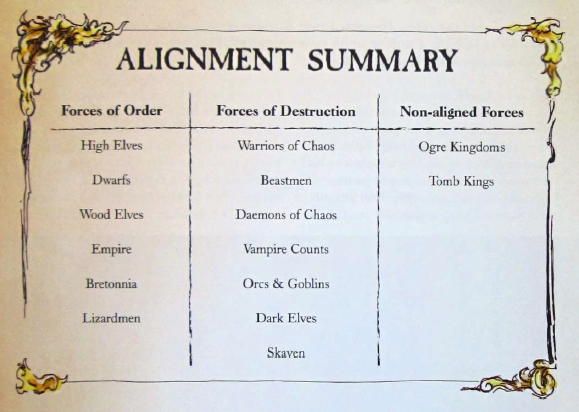
Ogre Kingdoms eat people. If the Good-Evil spectrum factors how the faction treats outsiders, then Ogres must be Evil.
Tomb Kings murdered their own citizens to enslave them for all time with necromancy. If the Good-Evil spectrum factors how the faction treats their lower classes, then Tomb Kings must be Evil.
I would put Wood Elves in the Neutral category. If you leave the Wood Elves alone, they will leave you alone. Wood Elves don't usually ride to the rescue of other groups unless it gives them a chance to catch one of their ancestral foes off guard.
The evil thing probably holds if you go on the assumption that being slavery is less evil than murder. Also, is necromancy a form of slavery or is just "gross abuse of a corpse"? Do the undead minions of the Vampire Counts suffer? Note that Dark Elves and Skaven generally follow up their slavery with murder.
I agree with you on the order for everything from Wood Elves down, more or less.
Brettonians, Lizardmen, Empire, Dwarves, and High Elves occasionally commit themselves to help other people. Not often though. Except for the Brettonians they all treat their own lower classes reasonably well. Brettonia probably helps other people enough to make up for them mistreating their own peasants. When I try to reank these groups by relative good I get a metaphorical headache.
Try it for 40k, where everyone is just a slightly different shade of absolutely vile evil.

Ok, but joke aside. For this to work we probably have to talk about a philosophical question first:
What is good and evil?
D&D defines evil mostly as selfishness and good as altruism. But how absolute is that measurement, and do we judge by outcome or intention? And is there a universal standard to agree on, or is behaviour measured within the system of values within a society? How much evil can a person or society do and still count as 'good' (or vice versa)?
20 years ago this was an ongoing topic in the D&D forum I was active on.
Examples:
- "altruism is selfish, too. People act altruistic to feel better. Every 'good' person is actually 'evil' if evil is defined as selfishness."
- "one evil deed can ruin a lifetime of good deeds"
- "one good deed can redeem a lifetime of evilness"
- "fans of eugenics think they would do good by killing all the disabled persons ('you have to break eggs to make an omelette'), making the people as a whole more healthy by removing the disabled ones from the gene pool."
- "that's not evil, that's tradition"
- "Mayans/Vikings/whatever were clearly evil because they used human sacrifices/raided settlements"
The additional problem is societies vs. individuals.
For a society we probably have to look at how they behave within their system, and toward others.
@Scalenex has a few very good points here (and in the other thread)
Let's take Dwarves.
They have some human village in their Book of Grudges because of... dunno... the mayor cut a dwarf's beard (does it work that way? Whatever). 80 years later (the mayor is long dead) they refuse to trade with that village during a famine because of that grudge, causing the death of 100 villagers.
Is that evil or not? And regardless of whether it is: does it make the Dwarven King evil? His government? The Dwarven society? All Dwarves?
I once wrote a D&D adventure for my group that challenged their views on some of those topics.
It had Dwarves (funny because one of the most honorable player characters was a Dwarf himself) that had human slaves. And most the humans thought it was totally OK as many of them were way better off that way. Most dwarves didnt see a problem with it either.
In the context of my adventure some of the slavers were actually the good guys, and some that opposed slavery were the bad guys.
That caused some major headaches among the players, and some fun/interesting situations and discussions.