
Slann
Scalenex
Keeper of the Indexes
- Messages
- 11,527
- Likes Received
- 20,495
- Trophy Points
- 113
My first Campaign Month, (other players second but I got a few extra things to make up for it)
Current Realm Allowance: 1500 points
Current Army: 1498 points
Slann, extra power dice, lore mastery, Divine Plaque of Protection (I can change Slann’s lore turn by turn if I choose)
Skink Priest, Cube of Darkness
25 Saurus FC
24 Skink, 3 Kroxigor FC
10 Javelins + Brave
2 x 7 Chameleon Skinks + Brave
2 x Salamander Team + Snack
Potential New Units: Jungle Swarms, Skinks Cohorts (no Krox), Skink Skirmishers, Chameleon Skinks, Salamanders, Razordons, Max 3 Skink Chiefs, Max 2 Temple Guard
Warchest: 0 Soft Resource units, 0 Hard Resource units, 0 Magic Resource units
Production at the end of the month: 67 S, 40 H, 28 M
Realm Tile Count (does not factor in productivity of tiles or standing army)
Ogre Kingdoms 4
Warriors of Chaos: 3
Dark Elves 3
Vampire Counts 3
Chaos Dwarves 2
Beasts of Chaos 2
Dwarves 2
Lizardmen (Me): 2
State of the Lizardmen Realm
Tile One (river through forested hills): Keep, Village, Temple, Mage Tower, Animal Farm, Mine
Tile Two (mangrove swamp): Guardtower, Herbalist
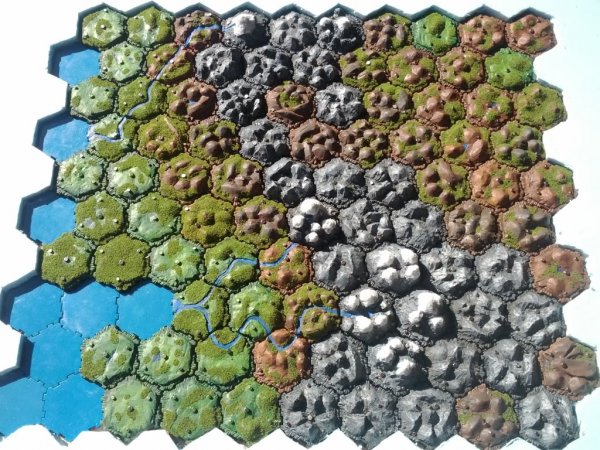
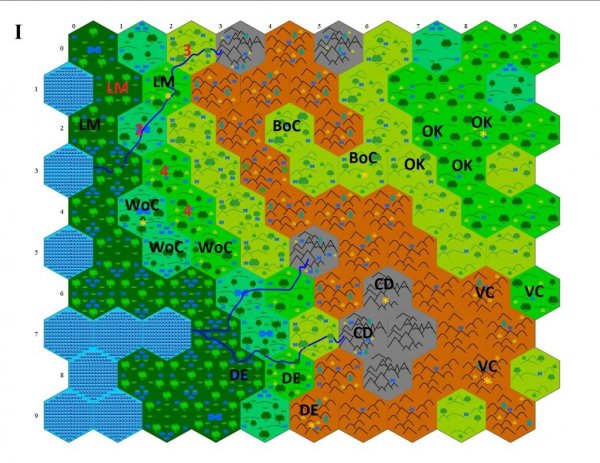
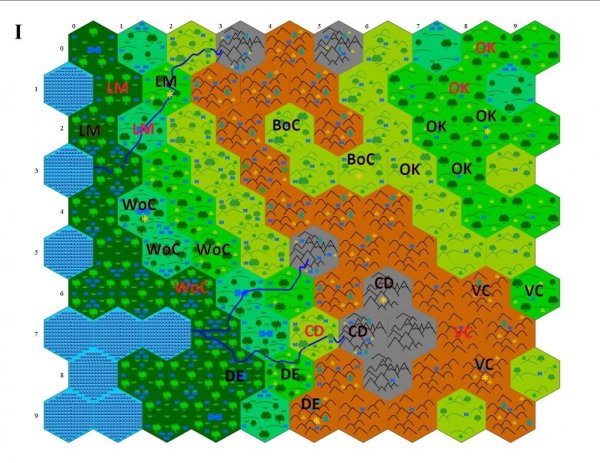
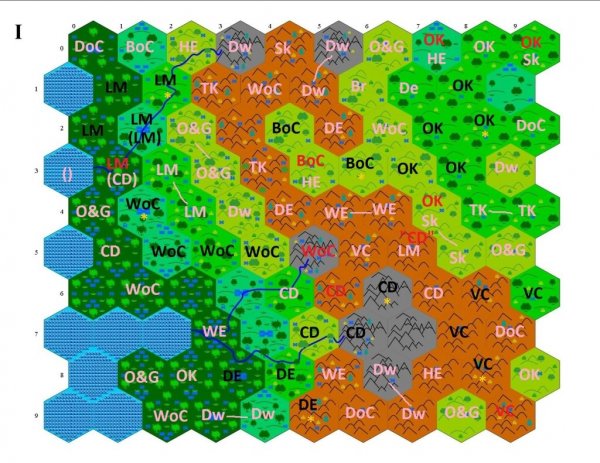
Me and seven other players are contesting around 100 hexagons on a big map. There is an underdark map too, but I’m not allowed to look at it until I control an entrance to the Underdark. The objective is to get as much territory as we can. Each tile has a rating in Elevation, Vegetation, and Hydration that affects productivity of a tile and units able to produced. The map is very realistic. A mountain range splits the Western third of the map from the Eastern two thirds. The thickest mountains are in the spine of the mountain and then it levels off to the west and east. The west borders an ocean and there is a realistic rain shadow so the areas to the west of the mountains have a lot more water than the eastern two thirds. Pretty much the whole coast is low lying wetlands described narrative-wise as mangrove swamps.
Most of the map is controlled by independent armies. If a player tries to conquer an independent army, one of the other campaign participants or the game referee who has many different armies will make a small force to oppose them. The independents either control one Hexagon with a 500 point army, or two Hexagons with a 1000 point army. Each player currently has a 1500 point army. We can move armies every week. Every “week” we can roll dice to heal casualties on units that aren’t completely destroyed. Every “month” we buy new units from the production in our territories, but we don’t get anything until then so while a 1500 point army can own a 500 point army, if they take too heavy losses in one week, their conquest options are poor until the end of the month.
We get 500 points maximum units per hexagon, plus additional points for villages, towns, cities, and metropolis improvements. Military and religious buildings give us bonus garrison troops that don’t count towards our maximum army allowance, but can’t leave the territories they guard. Our initial 1500 point army is whatever we want, additional constructions are based on the territory’s basic terrain (Salamanders require controlling wetlands, Terradons require highlands) and building improvements (Temple Guard require a Temple, Cold Ones require a Stables). Apart from our first 1500 points, our units aren’t free and we have to allocate resources we gather from our territories which can be spent on more units or more buildings. Unit champions cannot be bought except for our starting armies. From here on out we get free unit champions if a unit gains experience points from performing well in battle. If a unit with a champion performs consistently well, the champion can eventually be swapped for a free hero. If a champion slays a character in a challenge they get promoted to hero for free.
I started a game week later than most, the other guys mostly have three territories and I have two. I got a nice consolation prize. I got to more or less pick where I started so I have a nice swampy spot in the NW corner. A lot of my units require “wet” hexagons, so I have my most basic needst met from the start. Other players are stuck with subpar terrain for their favorite units and have to expand in very specific directions. The Chaos Warriors have wet low lying territories and they are moving towards the mountains. Very few other armies’ units need watery territories, so I don’t expect people to be gunning to steal my swamps. As an added, plus player armies risk a small number of casualties when moving through extreme terrain (dense forests, swamps, and high mountains). LM are immune to those casualties for moving about “wet” territories so I have an added layer of defense versus invaders staking out the swamp land. The downside is that with low lying territories, is tha I don’t collect the resources used for building production as fast as people in hilly dryer regions. We harvest resources to build armies and realm improvements collecting soft resources or S (food and animals), H resources (minerals and timber) and magic resources or M (rare herbs and precious metals). Rather than go through all the tiny details. My S is good right now, my H is adequate, and my M is very good (compared to the other players anyway, no one has lots of M right now).
I don’t have any players bordering my realm yet. A short distance south of me is a player realm of Warriors of Chaos. On the South campaign map edge is a Dark Elf Player. There are Chaos Dwarfs near the middle of the board. The NE corner has Ogre Kingdoms and Beastmen bordering each other. I believe they fought once and the Ogres took a tile from them. The SE corner has a Vampire Counts player, and below him somewhere on the underground map is the Dwarf Player’s Realm.
Short Term Plan: My two territories aren’t linked, they are separated by independent territories. Independent LM territories have a 1 in 3 chance of joining me without a fight when invaded and there happens to be an independent LM territory separating the two tiles in my realm, so I invaded that one. The LM there decided NOT to join me, so I have to play out the battle next week. The same 500 point army list inflicted about 600 points of damage on an attacking 1000 point army of dark elves before dying. I’m not too worried with a 1500 point army.
Then we have another campaign turn, I plan to take a 500 point Skaven territory. Unless the two 500 point armies inflict extremely heavy losses on my army, I’ll go south again after the reinforcement phase and take the two Hexagon 1000 point Lizardmen realm after building additional units and hope they join me without a fight. I want to make sure my army is pretty strong before I take it in case they fight back. That expansion would give me a shared border with the Warrior of Chaos player. If I take heavy losses moving there, my army would be a very tempting target for the WoC.
Long-Term Plan: When I play Risk, I am often too aggressive and I end up angering people and making too many enemies too soon. I plan to play conservatively and not make waves. I don’t plan to attack a non-independent realm until I run out of space or I am attacked by someone else. I plan to solidify control of the NE corner and control all the territories that make up the northern most river (rivers give nice bonuses). Once I have my corner, I don’t know where to go from there, and no plan survives contact with the enemy. By the time I have the corner conquered, there will be very few independent territories left so I will make future plans based on the moves of rival players. I need to hoarde some H resources so I expand my capital’s village to a town. A town is a prerequisite for Saurus Warriors and Scar Vets.
Except for the Ogre player (who is far away from me), the other players seem to be concentrating on taking easy independent realms as opposed to attacking rival players at this early stage. Once our armies build up larger I’m sure that will change. If attacked, I will proportionally respond, but I do not want to be the aggressor, until I have no more independent realms to expand into. My main concern are my Warriors of Chaos neighbors to the South. The Dark Elves are my second closest neighbor, I don’t know the DEs require for their units, but they are the most likely army besides me to be after wetlands and may get some campaign bonuses for controlling the coast. I’m a little worried about the dwarves taking the underground realms without a fight, but I’m not in a position to stop them. The risks are high and the payoffs small for me venturing into the Underdark and the nearest entrance to me to the under dark is fairly distant. Hopefully the Dark Elves and Chaos Dwarves will head underground and keep the Dwarf player in check. The Ogre player is theoretically in first place, and the Beastmen in last place. takes immediate steps moves on the Beastmen capital, I’ll take it as a sign of a more aggressive gain.
I’ll update the state of the campaign “week” by “week” if people are interested in reading about this. We are likely to play about one campaign “week” every two weeks in the real world. It’s fairly complicated I left out the math that calculates production and a description of what all the buildings do.
Current Realm Allowance: 1500 points
Current Army: 1498 points
Slann, extra power dice, lore mastery, Divine Plaque of Protection (I can change Slann’s lore turn by turn if I choose)
Skink Priest, Cube of Darkness
25 Saurus FC
24 Skink, 3 Kroxigor FC
10 Javelins + Brave
2 x 7 Chameleon Skinks + Brave
2 x Salamander Team + Snack
Potential New Units: Jungle Swarms, Skinks Cohorts (no Krox), Skink Skirmishers, Chameleon Skinks, Salamanders, Razordons, Max 3 Skink Chiefs, Max 2 Temple Guard
Warchest: 0 Soft Resource units, 0 Hard Resource units, 0 Magic Resource units
Production at the end of the month: 67 S, 40 H, 28 M
Realm Tile Count (does not factor in productivity of tiles or standing army)
Ogre Kingdoms 4
Warriors of Chaos: 3
Dark Elves 3
Vampire Counts 3
Chaos Dwarves 2
Beasts of Chaos 2
Dwarves 2
Lizardmen (Me): 2
State of the Lizardmen Realm
Tile One (river through forested hills): Keep, Village, Temple, Mage Tower, Animal Farm, Mine
Tile Two (mangrove swamp): Guardtower, Herbalist
Me and seven other players are contesting around 100 hexagons on a big map. There is an underdark map too, but I’m not allowed to look at it until I control an entrance to the Underdark. The objective is to get as much territory as we can. Each tile has a rating in Elevation, Vegetation, and Hydration that affects productivity of a tile and units able to produced. The map is very realistic. A mountain range splits the Western third of the map from the Eastern two thirds. The thickest mountains are in the spine of the mountain and then it levels off to the west and east. The west borders an ocean and there is a realistic rain shadow so the areas to the west of the mountains have a lot more water than the eastern two thirds. Pretty much the whole coast is low lying wetlands described narrative-wise as mangrove swamps.
Most of the map is controlled by independent armies. If a player tries to conquer an independent army, one of the other campaign participants or the game referee who has many different armies will make a small force to oppose them. The independents either control one Hexagon with a 500 point army, or two Hexagons with a 1000 point army. Each player currently has a 1500 point army. We can move armies every week. Every “week” we can roll dice to heal casualties on units that aren’t completely destroyed. Every “month” we buy new units from the production in our territories, but we don’t get anything until then so while a 1500 point army can own a 500 point army, if they take too heavy losses in one week, their conquest options are poor until the end of the month.
We get 500 points maximum units per hexagon, plus additional points for villages, towns, cities, and metropolis improvements. Military and religious buildings give us bonus garrison troops that don’t count towards our maximum army allowance, but can’t leave the territories they guard. Our initial 1500 point army is whatever we want, additional constructions are based on the territory’s basic terrain (Salamanders require controlling wetlands, Terradons require highlands) and building improvements (Temple Guard require a Temple, Cold Ones require a Stables). Apart from our first 1500 points, our units aren’t free and we have to allocate resources we gather from our territories which can be spent on more units or more buildings. Unit champions cannot be bought except for our starting armies. From here on out we get free unit champions if a unit gains experience points from performing well in battle. If a unit with a champion performs consistently well, the champion can eventually be swapped for a free hero. If a champion slays a character in a challenge they get promoted to hero for free.
I started a game week later than most, the other guys mostly have three territories and I have two. I got a nice consolation prize. I got to more or less pick where I started so I have a nice swampy spot in the NW corner. A lot of my units require “wet” hexagons, so I have my most basic needst met from the start. Other players are stuck with subpar terrain for their favorite units and have to expand in very specific directions. The Chaos Warriors have wet low lying territories and they are moving towards the mountains. Very few other armies’ units need watery territories, so I don’t expect people to be gunning to steal my swamps. As an added, plus player armies risk a small number of casualties when moving through extreme terrain (dense forests, swamps, and high mountains). LM are immune to those casualties for moving about “wet” territories so I have an added layer of defense versus invaders staking out the swamp land. The downside is that with low lying territories, is tha I don’t collect the resources used for building production as fast as people in hilly dryer regions. We harvest resources to build armies and realm improvements collecting soft resources or S (food and animals), H resources (minerals and timber) and magic resources or M (rare herbs and precious metals). Rather than go through all the tiny details. My S is good right now, my H is adequate, and my M is very good (compared to the other players anyway, no one has lots of M right now).
I don’t have any players bordering my realm yet. A short distance south of me is a player realm of Warriors of Chaos. On the South campaign map edge is a Dark Elf Player. There are Chaos Dwarfs near the middle of the board. The NE corner has Ogre Kingdoms and Beastmen bordering each other. I believe they fought once and the Ogres took a tile from them. The SE corner has a Vampire Counts player, and below him somewhere on the underground map is the Dwarf Player’s Realm.
Short Term Plan: My two territories aren’t linked, they are separated by independent territories. Independent LM territories have a 1 in 3 chance of joining me without a fight when invaded and there happens to be an independent LM territory separating the two tiles in my realm, so I invaded that one. The LM there decided NOT to join me, so I have to play out the battle next week. The same 500 point army list inflicted about 600 points of damage on an attacking 1000 point army of dark elves before dying. I’m not too worried with a 1500 point army.
Then we have another campaign turn, I plan to take a 500 point Skaven territory. Unless the two 500 point armies inflict extremely heavy losses on my army, I’ll go south again after the reinforcement phase and take the two Hexagon 1000 point Lizardmen realm after building additional units and hope they join me without a fight. I want to make sure my army is pretty strong before I take it in case they fight back. That expansion would give me a shared border with the Warrior of Chaos player. If I take heavy losses moving there, my army would be a very tempting target for the WoC.
Long-Term Plan: When I play Risk, I am often too aggressive and I end up angering people and making too many enemies too soon. I plan to play conservatively and not make waves. I don’t plan to attack a non-independent realm until I run out of space or I am attacked by someone else. I plan to solidify control of the NE corner and control all the territories that make up the northern most river (rivers give nice bonuses). Once I have my corner, I don’t know where to go from there, and no plan survives contact with the enemy. By the time I have the corner conquered, there will be very few independent territories left so I will make future plans based on the moves of rival players. I need to hoarde some H resources so I expand my capital’s village to a town. A town is a prerequisite for Saurus Warriors and Scar Vets.
Except for the Ogre player (who is far away from me), the other players seem to be concentrating on taking easy independent realms as opposed to attacking rival players at this early stage. Once our armies build up larger I’m sure that will change. If attacked, I will proportionally respond, but I do not want to be the aggressor, until I have no more independent realms to expand into. My main concern are my Warriors of Chaos neighbors to the South. The Dark Elves are my second closest neighbor, I don’t know the DEs require for their units, but they are the most likely army besides me to be after wetlands and may get some campaign bonuses for controlling the coast. I’m a little worried about the dwarves taking the underground realms without a fight, but I’m not in a position to stop them. The risks are high and the payoffs small for me venturing into the Underdark and the nearest entrance to me to the under dark is fairly distant. Hopefully the Dark Elves and Chaos Dwarves will head underground and keep the Dwarf player in check. The Ogre player is theoretically in first place, and the Beastmen in last place. takes immediate steps moves on the Beastmen capital, I’ll take it as a sign of a more aggressive gain.
I’ll update the state of the campaign “week” by “week” if people are interested in reading about this. We are likely to play about one campaign “week” every two weeks in the real world. It’s fairly complicated I left out the math that calculates production and a description of what all the buildings do.