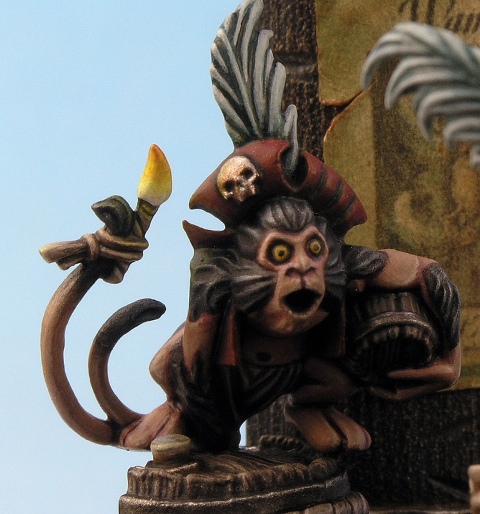
Is this from the Seraphon book? It doesn't look familiar to men, I don't have that specific book. Maybe the Lustria Campaign Book?
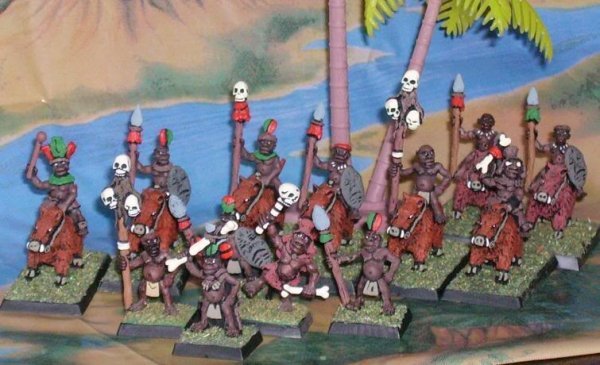
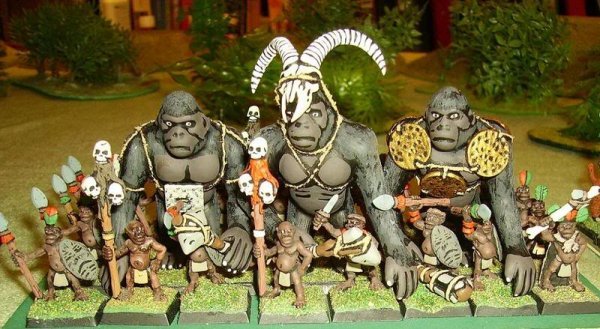
There was a passage in one of the old Warhammer Fantasy editions talking about the different types of Beastmen across the globe, with it a line about gorilla-Beastmen in the Southlands (jungles of Warhammer-Africa) and tiger-Beastmen in Warhammer-India
It was from a Lustria wiki page, I know anyone can edit wiki's though,
here's the full thing. sorry for the long read!
"
Now that I have seen Lustria with my own eyes I believe the tales are true - both of the gold that can be pried out of every ruin, and also of the denizens of that cursed land. Lizardmen, savage in deed and heart. It matters not the price, I will not return to those forsaken jungles again."
—From the logbook of Vincenzo Corenzo, Mercenary Capitano out of Tilea

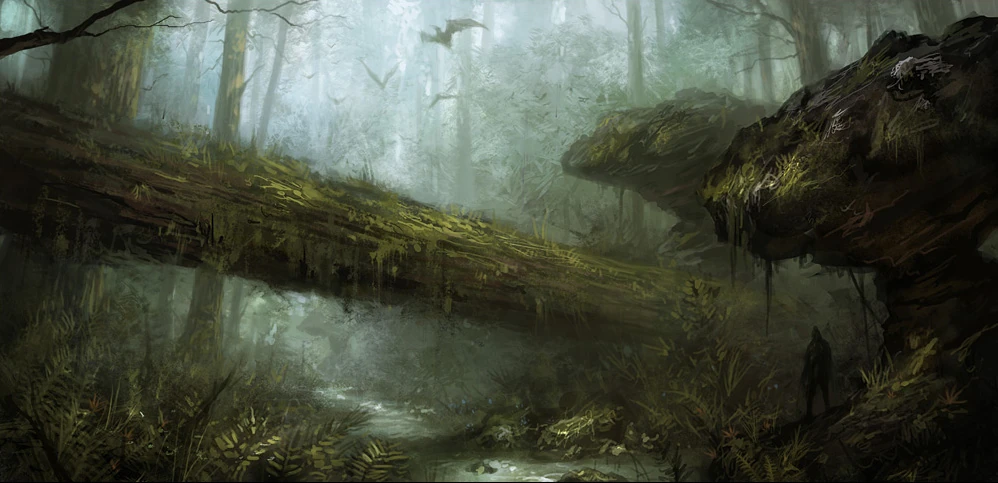
The damp rainforest jungles of Lustria
Lustria is a large, tropical continent located within the southern hemisphere of the
New World and is considered to be the rightful domain of the
Lizardmen race. For long ages of the world, the mysterious continent of Lustria has remained hidden to outsiders. This is not by accident or by some geographical oddity, but rather by strongly maintained magical wards, enchantments which disorient intruders. Those that manage to pass through the unseen barriers find other dangers — Lustria’s coasts are home to treacherous tides, unnatural eddies and typhoons of great power. In its clear blue waters lurk scaled reptilian beasts whose jaws can splinter a ship’s hull.
While the waters surrounding Lustria are perilous, the whole of the enormous continent is one of the most hostile regions in the entire world. The majority of its landmass is covered in jungle, a dark abode where death comes in myriad guises. Mighty, prehistoric carnivores rule the forests — some actively stalking their prey, while others lurk in ambush, awaiting whatever wanders close. No less deadly are the jungle’s smaller killers; everywhere, debilitating parasites lurk, awaiting their opportunity to latch onto a new host, and the humid air buzzes with swarms of blood-sucking insects so voracious they can exsanguinate a man before his body can collapse to the forest floor.
Only the Lizardmen and other cold-blooded creatures can endure the stifling heat and humidity for long; other races eventually sicken and die. To its native Lizardmen, however, Lustria is a haven — a deathtrap to invaders and a bulwark against the disorder set loose in the world with the coming of Chaos. Lustria contains mighty rivers, vast tracts o f unbroken swampland, arid deserts, soaring mountains and a vast and fertile plain - deep grasslands and savannahs that stretch beyond the horizon. Yet one feature dominates all others.
Contents

The
Slann record that Lustria was originally attached to the
Southlands. As part of the
Old Ones'
Great Plan, the two were separated by the
Great Ocean and changed from barren wastelands into fertile jungles. It was around this time that most of the
Lizardmen temple-cities were founded and populated.
When Chaos first entered this world, Lustria wasn't as dangerous a continent when it first came into being. In desperation, they enchanted the jungle, turning their surroundings into a deathtrap full of carnivorous plants, living quicksand pits and teeming swarms of insects whose stings could crack Dragon scale. Rivers were redirected to impede the daemonic advance and volcanoes rose and erupted to slow their hellish progress. After the
Great Catastrophe in which
Chaos entered the
world,
Skaven were the first of the younger species to vie for control of Lustria. There,
Clan Pestilens infected many Lizardmen with a plague that weakened their power and caused many of their cities to fall into ruin. This was only reversed with the rise of the Serpent God
Sotek and his prophet
Tehenhauin, around the
Imperial Year 0, who drove the Skaven out of Lustria.
Before the discovery of Lustria by the
Norses, a trading vessel from the Old World was caught in the fierce currents off the coast of
Araby and swept into the swirling waters of
Ulthuan. The wrecked ship was washed up months later on the southeastern shore of Lustria. Unbeknownst to the crew, one of their passengers,
Luthor Harkon, had been a
vampire and although all the humans died in the disaster, the vampire and his offspring lived and founded a new realm of
Undead in the
New World, known as the
Vampire Coast. The first human to reach Lustria (and survive) was the Norse seafarer Lost Erik, who recorded landing on an island just off the coast of Lustria and looting gold from Lizardmen. He failed to realize the extent of the land and it was drawn on maps as a small cluster of islands.
Lost Erik's son, named
Losteriksson, was the first Old Worlder to reach the mainland of Lustria. After trekking inland in search of treasure, Losteriksson and his men left Lustria as rich men, only to return and settle down where they first landed, naming the settlement
Skeggi, after Losteriksson's daughter, the first human to be born in the New World. Since Losteriksson returned with gold and riches, Lustria has been a popular destination for adventurers seeking to make a fortune and this has resulted in several Lizardmen cities being looted. The increase in traffic to Lustria has also increased the number of ships wrecked on its coast, which has served to swell the number of helpless victims the Undead of the Vampire Coast can add to their ranks.
Geography
"
On the fifth day of our expedition we lost yet another member of our party, but this time through the depredations of the native fauna rather than through disease or malnutrition. Making our way northwest along a shallow, fast-flowing stream, the lead man stopped dead in his tracks, indicating with a petrified expression the water breaking around his feet. All stopped and looked down to the water, where we spied a glossy black tentacle working its way slowly up his leg. Not a man knew what to do, but soon it was too late to do a thing for the poor wretch was yanked most violently beneath the surface where a great commotion went up. In a short moment, the thrashing ceased and silence descended Then, a great jet of gore ascended, showering all with blood and gristle. Upon wiping the filth from my eyes I discovered myself alone, my companions having demonstrated the good sense to flee for their lives. Seeing the wisdom of their actions. I joined them forthwith..."
—The journal of Johann Beckhein, day 5

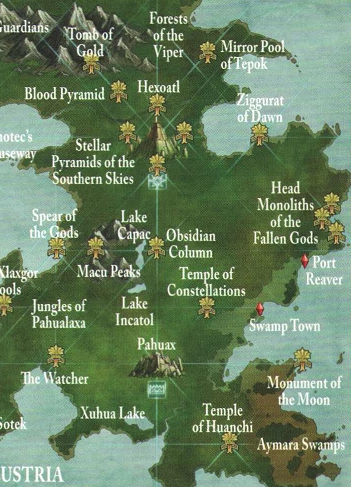
A map of Lustria
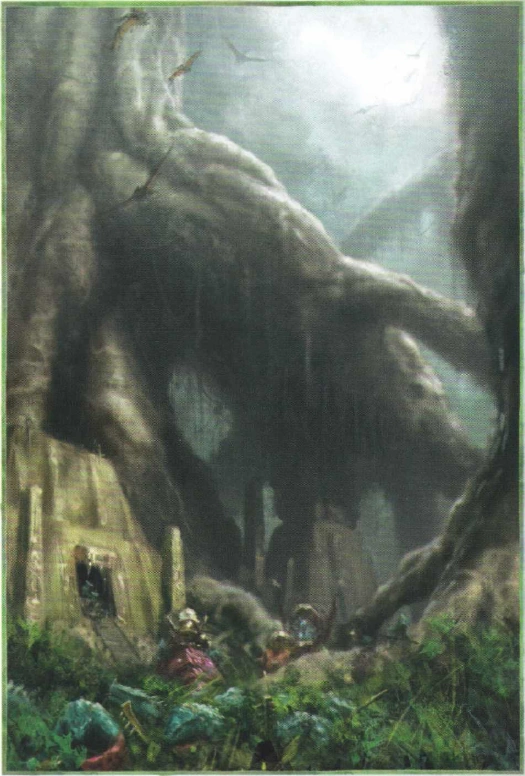
At least four-fifths of Lustria is covered in jungle so thick that its many levels of canopy block out the sky. Even the high peaks and plateaus are blanketed, and it is said that arboreal creatures can cross the entire continent without once stepping upon the ground. In places, the trees soar many hundreds of feet in the air and are older than the race of
Man. The jungle floor is choked by dense undergrowth and there are few true paths beyond animal trails. Visibility is limited and the air is thick, often wreathed in drifting mists.
To an outsider, the claustrophobic jungles of Lustria are much the same, but to its native creatures, nothing could be further from the truth. The dense ferntree valleys, the titanic skywoods and the moss-covered flood zones each offer their own deadly perils. To creatures that have lived their lives braving such dangers, it becomes instinctive to identify the hundreds of different environments, anticipating the types of plants and creatures that might lie in ambush. In the jungle, you are always being stalked - knowing by what can mean the difference between life and death. To intruders, it is an alien landscape, a singular green hell, where anything (or everything) is trying to make a meal of them.
A great amount of the plant life of Lustria is carnivorous - grasping creeper vines, blood-hungry spore clouds and impaling spikethorns all seek the unwary. Yet even the omnipresent dangers of lethal flora pale in comparison to the many creatures that make the jungle their hunting ground. Every hanging vine might be home to fist-sized stinging insects, and prides of scale-maned
reptilions wait in concealment ready to pounce upon passers-by. Great hunting cats, cannibalistic monkey-kin, and the buzzing swarms of enormous insect life make the jungle a constant battle zone, where survival is an hourly struggle, let most dangerous of all that hunts beneath the canopies are the giant reptiles. These beasts have long been extinct from the rest of the
world, but in Lustria, they rule supreme.
Swift-moving colonies of bipedal razorbeaks scurry through the underbrush, while packs of
Cold Ones hunt the game paths, seeking fresh meat. From the canopies above swoop down
Terradons and all manner of lesser winged reptiles. The jungle floor trembles with the tread of the mighty
Stegadons, their passage uprooting trees and making shortlived roads through the jungle. Enormous sauropods stretch their necks to pluck creatures out of even the uppermost branches, while plodding
Thunder Lizards actually penetrate above the canopy, seeking to swallow entire cloud banks, altering weather patterns for miles around in order to charge the fearsome attacks they use to kill their prey. In the deepest jungle, rarely seen even by the
Lizardmen, lurk strange, feather-winged serpents, multi-legged behemoths and the mysterious
Arcanadon. Yet all of these creatures know fear when they hear the roar of the
Carnosaur — for none are safe from the relentless ferocity of that king of savage killers.