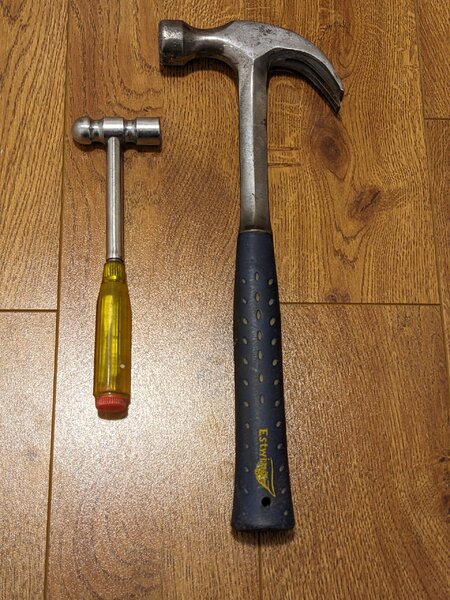
The issue is that in this analogy, the level 4 wizard is a proper hammer. And the level 2 wizard is a chocolate hammer.
Sure the chocolate hammer has a purpose, but it's purpose is not to be a useable hammer.
A level 4 wizard applies a large casting/dispelling bonus (of 4+) while a level 2 does the same but only applies a smaller bonus of 2+. That's just like a large hammer applying a large amount of force on a nail while a small hammer applies less force on the nail. In both cases they are doing the same thing, but to varying degrees. In both cases they are tools.
The chocolate hammer retort makes no sense. One is a tool and the other is a food item. They are different things entirely. The lower level wizard is still a wizard. The lower level wizard can still cast spells. The lower level wizard still helps to
mitigate some of the opposing wizard's magic. Just not to the same level as the level 4.
This boils down to "field enough magical support to basicly level up your wizard", which doesn't really adress the critique that "high level" wizards stomp low level wizards to the point of undermining magic as a system.
Well... yes. What do you expect? Are you saying that a low level wizard (who costs less points) should match a high level wizard (who costs more points) without some sort of additional magical investment?
High investment in magic
WILL, on average, stomp low investment in magic, at least in terms of the magic phase (but concessions will have to be made elsewhere). That does not undermine the magic system. In fact, anything other than that result would undermine the magic system!
Also, it doesn't even begin to address the issue for non-magical factions who only bring the occasional wizard, which are the ones who suffer most from this flawed magic system.
There is only one non-magical faction in the game, which are the vanilla Dwarfs.... and even then, they do have magical defense. Additionally, they are a solid upper-mid tier army, so they're not exactly lacking.
If we instead consider army lists with limited or no magic at all, that is a strategy choice by the player. Sure, they will undoubtedly be hurt in the magic phase, but in return they should have some or all of their other phases enhanced depending on how they allocated the points they saved on magic. Magic is hardly the end all and be all of Warhammer. It isn't even the most impactful phase of the game (that being movement followed by [in most cases] the close combat phase). I discussed this
previously on this tread:
"
Was magic (outside of those select few uber spells) that overpowered in 8th?
I think we often suffer from a slightly distorted view of how effective it actually was. Could it win you the game... yes, sometimes. Could it be a complete point sink, doing little to nothing... also yes, sometimes. I think some of it comes down to recall bias that humans tend to suffer from. We tend to remember singular large effects more readily than more common smaller ones. So that one time that Purple Sun wipes out a Lizardmen or Orge army is for more readily recalled than the 20 other games where it had little, no or a moderate effect. And that's referring to one of the most broken spells in the game, which I agree should be toned down. Consider, there are only a handful of spells in the game that have that level of potential.
So to play devil's advocate against magic, consider the following:
- magic is typically expensive and usually quite squishy on the battlefield. A level 4 wizard is usually not cheap, quite soft and has a huge bulls-eye painted on its back. Those are valuable victory points for your opponent to capture, and also represents a significant points investment that could have bought you several more war machines or a truly potent close combat unit.
- the two most powerful armies in terms of the magic phase (the TK and the Beastmen) were both bottom tier in terms of competitiveness. Magic could not offset their weaknesses in the other phases. On the flip side, the Warriors of Chaos had very mediocre magic (and next to no shooting) but easily made up for this with Close Combat prowess and movement potential. Dwarfs have no magic (though they do have magic defense) and they are a very potent army. Shooting, close combat and magic defense easily make up for their lack of a magic phase.
I've seen games where magic punched above its weight, at its weight or well below its weight. Magic is fickle. Investing in the other phases offers far more reliability. But, the fickle nature of magic will mean that every once in a while it will have a highly memorable game-winning effect.
Lots of players invested a huge percentage of their points allowance on magic. It wasn't particularly uncommon to see a quarter of an army's points invested in wizards. So yeah, you'd expect 650 points of wizards to have a significant effect on the battlefield, but so can a pair of K'daai Destroyers for the same points cost.
I think the real issues were tied to those 5 or 6 really overpowered spells sprinkled across the entire game; of which Dweller's below and Purple Sun were the most famous examples. What made it particularly bad was that they unfairly disadvantaged certain armies in the game. Purple Sun could single handily defeat a Lizardmen or Ogre Kingdoms army. In fact, the Ogre Kingdoms could be every bit considered a top tier army alongside of the WoC, HE and DE armies if it wasn't for that one spell. Purple Sun is the one thing that kept them out of the very top echelon of armies. That was a bit of poor game design in my opinion, but even then it was never a sure thing."
Sure, give me a strategy that allows a low level wizard to do his thing when faced with a high level opponent without being utterly dominated.
And for clarity "have someone else kill the high level wizard" or "avoid the high level wizard" are strategies that fully admit the low level wizard gets dominated and can't do anything meaningfull in a direct confrontation.
I smell a strawman argument. I never said that the lower level wizard won't get dominated. That was never my position. My argument was (and continues to be) that the level 4 wizard will
rightfully be better (at magic) than the lower level wizard. This is not a design flaw, but the way it should be! *bolded for emphasis*
You can still slip spells through with lower level wizards depending on:
- your winds of magic roll
- the army you are fielding (and hence the magical support at your disposal... i.e. Casket of Souls, Chalice of Blood and Darkness, etc.)
- the strategy you employ in your magic phase
Yes, the level 4 does it better (as he should!), but its not like I would have no magic phase at all with my level 2.
So to answer the question within the context of how I originally laid out my argument (i.e. the level 2 wizard can still slip spells through):
Since we're looking at how a level 2 can slip spells past a level 4, we'll be looking at this through the vantage point that it is the level 2's magic phase (and the level 4 is the dispeller).
Ignoring outside influences (supporting units, magic items, special rules) and discounting channeling (which multiple lower level wizards actually have an advantage in), the power dice and dispel pool are determined by a roll of 2d6. The actual absolute number rolled is not relevant for our discussion here, but the difference between the two dice pools is. The power dice will equal the combined sum of the two dice rolled and the dispel dice is simply the highest of the two dice rolled. What this means is that:
- the power dice pool will always be larger than the dispel dice pool
- the difference between the two pools of dice will always be 1, 2, 3, 4, 5 or 6 (in favour of the power dice)
In our little setup, the level 2 wizard contributes 2+ to cast and the level 4 wizard contributes 4+ to dispel. That gives the level 4 wizard a 2+ advantage per cast/dispel duel attempted. Keep in mind the average roll on a single die is 3.5.
So let's assume that each wizard rolls mathematical averages, because obviously good or bad dice rolling can radically swing things in either direction.
Scenario #1 - A good dice roll for the level 2's winds of magic roll: 4 & 4 [meaning 8 power dice and 4 dispel dice]
If the level 2 has one good spell to cast, he throws 6 dice at it.
Casting result = 6d6 casting roll + 2 for the wizard levels = 21 + 2 =
23
The level 4 is in a pickle now. He is mathematically unlikely to dispel the cast with his 4 dispel dice. On average we're looking at 4d6 + 4 = 14 + 4 = 18.
So odds are that the spell goes through.
Alternatively, the level 2 might have two viable spells to cast. In this case he can throw 4 dice at each. The level 4 is favoured to dispel one of these two casts with his 4 dispel dice and 4+ to dispel, but he'd have no chance of stopping the other one then.
So again, odds are that the spell goes through.
Scenario #2 - A bad dice roll for the level 2's winds of magic roll: 3 & 2 [meaning 5 power dice and 3 dispel dice]
The level 2 throws 5 dice at his spell. Average casting result = 5d6 + 2 = 19.5
The level 4 has no choice but throw all 3 of his dice to dispel. Average dispel result = 3d6 + 4 = 14.5
So odds are that the spell goes through.
Scenario #3 - A really bad dice roll for the level 2's winds of magic roll: 1 & 1 [meaning 2 power dice and 1 dispel dice]
The level 2 throws 2 dice at his spell. Average casting result = 2d6 + 2 = 9
The level 4 has no choice but throw his one die to dispel. Average dispel result = d6 + 4 = 7.5
So odds are that the spell goes through.
As the math shows, even in the case of the smallest possible power dice to dispel dice advantage (a differential of 1), the spell should still mathematically go through. In such an extreme case, the margins are razor tight, as the dispeller only has to
match the casting value, but it's still there. As we increase the gap between the power dice and dispel dice pool, the effect only gets greater. So the level 2 will lose to the level 4 (especially on the defensive end), but it isn't the case that the level 2 is worthless and doesn't function as a wizard.
The trick with a wizard's bonus to cast/dispel is that it is cumulative. The more spells you cast (or try to dispel) per magic phase the greater its effect. So with all other things being equal, if you are at a bonus to cast advantage, you are better off casting more lower level spells with less dice (spreading your power dice out and repeatedly benefiting from your bonus to cast). Conversely, all things being equal, if you are at a bonus to cast disadvantage, you would be wiser to throw more dice at fewer spells (thereby limiting our opponents superiority in terms of dispelling bonus).
Of course this is a simplified look at things, there are other factors at play, but it does demonstrate that the level 2 can slip spells through.




 ), but in WHFB, what you're describing is not a problem.
 ) lord on the same dice roll? Go outside and try to catch a snail with your bare hands... and now a hummingbird. Not the same level of difficulty, hence it should not be represented by the same static dice roll. Or in terms of wounding... go punch a human and then a Kodiak bear. You won't do the same level of damage to both targets. It should always be an interaction between the attributes of the attacker and defender. Similarly, if you're casting/dispelling against a lower level wizard it should be easier (and more effective), and vice versa.