What you guys said, just with cartoons.
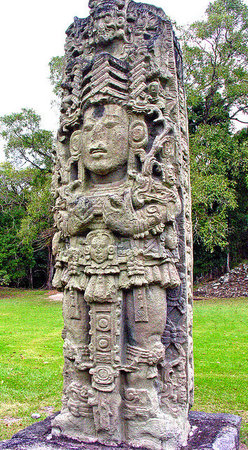
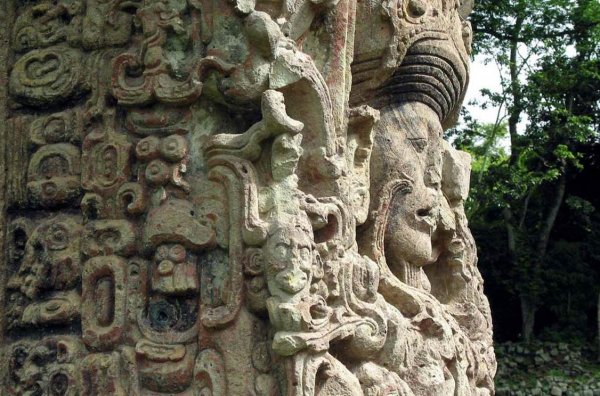
OK that was a lie. There is such a healthy divergence in interpretation of LM culture on this site that I think a hard and fast answer is unwise. So here it is. LM honour their dead and build memorials to and idealised memories of those deemed to be heroes of the Great Plan.
As a generalisation, LM would claim to be forward lookers, striving to the Great Plans objectives, but in truth they are compelled to live in the past, sifting through ambiguous plaques and records of events to find hints of where they should go next. For this reason alone, they would remember their heroes, analyse their deeds and attempt to model themselves on the most successful / ferocious proponents of cold blooded progress. This of course, is a giant trap which mostly serves to distort the LM view of history and their place in it, and it stifles innovation (effective use of allies) and invention (the wheel).
It's worth noting, that with the longevity of Slann and Oldbloods, many of the heroes of the past remain so in the present - which makes taking a progressive view of their achievements even harder. Also, I think Slann would be above / not engaged enough with normal passage of time to engage in remembrance of the dead for its own sake, but, man, I bet they wished they had practised when AoS came around.
In WHFB tradition, notable individuals are returned to the spawn pool of origin to nourish and hopefully influence future spawnings Therefore there must be a notion of venerating exceptional individuals. That new spawnlings could be deemed to have "the sacred markings attributed to Tzunki / Kroq-gar etc" indicates that an oral or written tradition must exist and that great individuals with particular physical attributes are noted in histories. This may not be to the point of building a flashy statue, but to reasonably utilitarian lizards, to be remembered and revered is significant.
In the Bobiverse, there must necessarily be a veneration of past glories and heroes. Bob requires all other LM protagonists to be longing for the good old days in order to give his main characters meaning as agents of change. In
Blood Dish, in the Temple City of Tlanxla, there is a Plaza of Heroes, Shrine of the Mighty, Hall of Fame which are beside the Pantheon of the Lost. No one complained at the time, and no they did not appear solely as a vehicle to propel the blink and you'll miss it "Hall of Fame" gag. Castes in the city had a robust view of their superiority to other castes. Given that all factions were adherents to the Great Plan, the only grounds for assigning oneself superiority on the basis of "species" would have been past glories by members of one's own caste.
In the Observance of @Tlac'Natai the Observer , individuals (Ahtunowhiho) revere and try to emulate fallen heroes and they despise weaklings. There is a concept of ownership, and I can imagine the messed up general keeping hold of a weapon once used by the saurus whose name I can't remember. In addition, my take on the place has brothers-of-the-same-water (spawnkin) collecting battle trophies to decorate their barracks. Their spawning accrues honour in this way - here they are seeking future reverence of the whole spawning rather than an individual.
In the sstrange but cosy world of @Essmir , the old chameleon skink (in Essmir's avatar and story -
Around the Fire) remembers his fallen spawn brothers and their deeds rather than obsessing about what General Tot'al'pwnaj might have been doing at the same time. This suits my world view about everyday heroes.
Sla Sla @Slanputin , Lustria's slowest story machine, has a pretty nasty hand pulling the strings which is happy to use personality cults to progress its own ends. For this to work, the twin concepts of "gods / heroes are better than us" and "absent gods / heroes can say whatever we want them to" need to be in the psyche of the reptilian sheep who occupy the
Golden City. Wake up people!
I can't really place other notable authors such as
@Kcibrihp-Esurc and
@Xholankha the lost one because they both write forwards so quickly, that it is hard to work out the background of their societies.
@RoseThorn is disqualified because there are
No Spawning Lizards in his story yet.
Which brings me to the cuddly world of @Scalenex of Malodorex (His characters live in the imaginary city of Klodorex, but the real half rotted, half crisped undead skink lives in his own smelly realm.) My knee jerk response is to say that if the citizens of Klodorex celebrated the glorious dead, they wouldn't have any time for anything else. In the spirit of saying something useful for once, his society has a very good sense of history and the place of heroes in it.
Six feet under. No! I must resist my cruel impulses!
His lizards sometimes triumph, sometimes fail. In this they are painfully human. Named characters have the insight to interpret the spin of the historians
but don't get to smugly enjoy their superior reasoning for long and judge the heroes / villains by their deeds. They can ignore the cult of Kaitar around them and say, "he was a big goof whose main asset was that the people followed him. He would have served his lords better by showing restraint and discretion." or "Zat-kai could have sold his daemon insight as an asset."
This makes me equivalent to a named character. I am so screwed.
So what about AoS? Do you remember how it made no sense that you could build an army with Kroq-gar, Tehenhuan and Tetto-eko because they occupied different times in history? AoS has fixed that by allowing dead lizards to return from memory and then wiping them from history anyway! Why aren't you grateful?
Assuming actual sentience and autonomy, I think celebration of the past and of fallen heroes would be MORE important to Seraphon. My preferred mechanic would be that the Slann calls the actual individual back (complete with their foibles and regrets) rather than (potentially) imperfectly remembers them. However, I write Seraphon stories the other way around because a poorly thought out existential crisis is better than no existential crisis at all.
@Bowser 's take in The Constellation almost had me in tears again (hope overcomes despair - it's like reading
@Slanputin backwards). Death has little meaning in Bowser's AoS, but triumph and heroism have value - because being forgotten is worse than dying. The terrifying alternative in
Extermination is that true death leads to the death of memory. This is about as opposite to what Scalenex is asking about as it is possible to get.