Hi all, I love me some LM as I have a decent sized army but I just wanted to point out and analyze, from a logical perspective, the arguments for and against Predatory Fighter working with Supporting Attacks. Bottom line is, RAW they don't and any argument that they do is based on a misreading of the rules/logical fallacy as I hope to illustrate below:
Before I begin, the main issue apparently is not just since Supporting Attacks means no special rules and therefore since Predatory Fighter is a special rule, that it can't be used when making Supporting Attacks. if it was then it would be an open/shut case. It is also that there is an alleged contradiction between BRB rule and Army Book rule and in such a case Army Book rule will trump BRB rule. The latter is a faulty argument as I'll discuss below along with my addressing all of the arguments in favor of PF working with SA. If I missed any arguments for, please let me know.
In case this post is TLDR, the arguments put forth for allowing Predatory Fighter to function with Supporting Attacks are invalid forms of argument and are logical fallacies. Therefore, there actually is no legitimate basis for Predatory Fighter working with Supporting Attacks RAW. Feel free to read each individual point I address for a complete analysis on what the problems with the arguments are and why they fail. Also, as an FYI, the arguments quoted are paraphrased by Darken from another thread on Dakka so if they are misstatements of the actual arguments I'd love to be corrected.
Argument 1: "(1) that frenzy increases your attack characteristic, predatory fighter doe not."
counterargument:
As discussed below, this first argument fails because it is actually (1) an invalid form of argument and (2) is a combination of the "begging the question" and "irrelevant conclusion" logical fallacies. Specifically, because you assume that (1) since the predatory fighter special rule generates an extra attack differently than most or all other special rules that grant an additional attack, that (2) Predatory Fighter can therefore overcome the no special rules prohibition from the supporting attacks rule. First, the form of this argument is invalid in that even though the premise may be true (that Predatory Fighter generates an extra attack differently than Frenzy or any other special rule that generates an extra attack); it does does not necessarily follow that Predatory Fighter can overcome the "no special rule" restriction for Supporting Attacks simply because of how it generates those extra attacks. Second, the argument is a "begging the question" fallacy because it assumes the conclusion to be true without providing any basis and it is an "irrelevant conclusion" fallacy because it argues that the functionality of a special rule is relevant to a restriction on the nature of a rule and the result of the rule where the restriction makes no mention about functionality at all.
Indeed, the Supporting Attacks rule makes no distinction with HOW any extra attacks are generated, Supporting Attacks makes a distinction as to the SOURCE of the of the extra attacks. Since Supporting Attacks specifically says "any special rule" the analysis is not HOW Predatory Fighter generates an extra attack but IF Predatory Fighter is a special rule that generates an extra attack. Since Predatory Fighter is a "special rule," supporting attacks negates it, regardless of HOW Predatory Fighter functions.
For example, if there is a law that says "on Tuesdays, you are not allowed to park your car on the street" it doesn't matter HOW a car ends up parked on a street, you are still not allowed to have the car parked on the street on Tuesdays. Argument #1 as quoted would be like arguing to the officer "but my mom parked the car on the street, it wasn't me!" That excuse makes no difference, the law was still broken. Likewise, Supporting Attacks says a model making a Supporting Attack is only ever allowed to make one attack, regardless of any special rules, regardless of how those extra attacks are generated.
Argument 2: " (2) predetory fighter attacks are determined after the number of supporting attacks have already been determined."
Counterargument:
As discussed below, this argument is again an invalid form and is a combination of a "begging the question" and "affirming the antecedent" logical fallacies. First, the form of this argument is invalid because the premise "the restrictions imposed by the 'Supporting Attacks' rule only apply when Supporting Attacks are generated" does not necessarily support the conclusion "therefore the restrictions cease to apply but the permissions do not." Just because the restrictions may or may not cease to function at one point in time does not mean the permissions do as well and visa versa. Second, the argument is a "begging the question" fallacy because it assumes the premise to be true to function at all (i.e., the timing issues) and it is an "affirming the antecedent" logical fallacy-but due to the complex nature of how the "affirming the antecedent" fallacy comes into play it will be discussed in greater detail below.
First of all, the actual language of the Supporting Attacks rule makes no distinction WHEN the extra attacks are disqualified or WHEN special rules are barred from taking effect. Essentially, you have to assume it does for this argument to function which is a logical fallacy ("assuming the conclusion/begging the question") and therefore the argument automatically fails and can be disregarded unless additional support is given. Furthermore, you have to "assume the conclusion"; again if you want to say Predatory Fighter allows a model making a Supporting Attack to make another Supporting Attack. Let me explain:
The first "assuming the conclusion" fallacy in this argument can be illustrated as follows:
The law says "on Tuesdays, you are not allowed to park your car on the street" and you are arguing "but it is now Wednesday so I can park on the street" but what is the basis you are using to say it is Wednesday and furthermore, what is your basis that you can even park your car on the street on Wednesday? Remember, Warhammer is a permissive rule set so you can only do something when expressly stated-the ability to do something in the game cannot be materialized out of the vagueness of a rule. Therefore, you have to assume that the restriction only applies when supporting attacks are generated, but that the permission to attack applies indefinitely. Furthermore, according to the law of excluded middle, something either is or it is not, so absent specific language that indicates otherwise, the Supporting Attacks rule functions in its entirety when Supporting Attacks are generated and then ceases to function in its entirety or it continues to function in its entirety thereby defeating this argument completely. Either all of a rule always applies unless stated otherwise or none of it applies unless stated otherwise, that is how things work in Warhammer. Otherwise you open the door to argue it can apply at any point and at that point it gets into a slippery slope logical fallacy which again causes this point to fail and yet there are other problems with this argument...
The second "assuming the conclusion" fallacy in this argument can be illustrated as follows:
Normally models not in base contact are not permitted to strike blows in close combat at all (absent a specific special rule that lets them), but the Supporting Attack rule lets them do so, but only one such attack may be made in this way. To get around the limitations of the Supporting Attack rule, you have to assume (1) a model is allowed to make more than one supporting attack per close combat phase; (2) that Predatory Fighter attacks generated can be Supporting Attacks; and/or, (3) that because a model was eligible to attack by virtue of the Supporting Attack rule, it is now eligible to attack later in the phase.
Regarding the first assumption, where in the written rules can anyone point to for support that a model can make more than one Supporting Attack per phase? This is important because the only way a model is eligible to attack another model not in base contact in combat at all (absent a specific special rule that lets them) is if it is a Supporting Attack but the BRB specifically says "a model may only make a SINGLE attack." The rules says you can only make one attack when making a supporting attack which implies only one supporting attack per phase unless otherwise specified (and Predatory Fighter does not specifically specify).
Regarding the second assumption, just because it says "attack" in the Predatory Fighter rule, it does not necessarily mean it is the same kind of attack the model made initially or that it is a Supporting Attack at all. In fact, it doesn't specify what kind of attack it is at all and you have to assume what kind it is for the argument to function. Indeed, not all attacks are supporting attacks and just because it says attack, you cannot automatically assume it means supporting attack (if you do this you are committing the "affirming the consequent fallacy). Specifically, there are regular close combat attacks which are made against models in base contact and a special, different kind of close combat attack made against models not in base contact (i.e., supporting attacks). So what is the specific basis anyone can hang their hat on to say that when Predatory Fighter says "Attack" it also means "Supporting Attack"? Hint: it can't be "because it says 'Attacks,' that those 'Attacks' can be a 'Supporting Attacks'" because that is a logical fallacy as described above.
Regarding the third assumption, you have to assume that because the model was initially allowed to make an attack by virtue of the Supporting Attack rule, the new attack generated can also be made against the same target of the Supporting Attack. This point forces you to assume that the Supporting Attack rule's permission to attack carries over but the limitations of that rule do not and there is absolutely no basis for that point (hence why it is an assumption). If the restriction ceases to apply, the permission must cease to apply with it unless otherwise specified. One can't just pick and choose what parts of a rule is applied to their models, either all of a rule applies or none of it applies unless specifically stated otherwise (see the specific vs. general rule distinction).
Argument 3: " (3) the special rule in the army book says if you make a close combat attack and roll a six make another attack using the usual rules for hiting and wounding. since supporting attacks are close combat attacks i see this rule overiding the brb in this instance. "
Counterargument:
This argument was partially discussed in point #2 and in my initial post (i.e., you have to assume the conclusion for it to be true/affirm the consequent and therefore the argument fails right out of the gate) but it goes a step further and even misstates the way the rules are written and function.
Specifically, just because it says "Attack," you are assuming it means "Supporting Attack" (as that would be the only way a model not in base contact could make an attack at all absent any other special rule, like the Kroxigor reach rule). "Attack"; does not necessarily mean"Supporting Attack"; as not all Attacks" are "Supporting Attacks" but "Supporting Attack" necessarily means "Attack" because all "Supporting Attacks" are "Attacks." So when one makes the argument "because Predatory Fighter says 'Attacks' and because a 'Supporting Attack' is an 'Attack,' I can make a 'Supporting Attack' via Predatory Fighter" they are reversing the logical implications of the rule and the way it functions (i.e., If P->Q, Q therefore P is the logical fallacy here-"affirming the consequent"). To spell it out, it makes sense to say all "Supporting Attacks" are "Attacks" but it does not make sense to say all "Attacks" are "Supporting Attacks" therefore when it says "Attack" one can't automatically assume or play it as if it is a "Supporting Attack."
Furthermore, this arguments misstate the rules in this point because the ONLY way Army Book>BRB is if there is a contradiction (as per the rule in the BRB). You have to assume there is a contradiction between the two rules when there is not necessarily a contradiction. Just because Predatory Fighter says you "make another attack" does not necessarily mean that the extra attack ignores any limitations or restrictions imposed upon the model with the special rule by any other rule out there. Also, the only time there actually is a contradiction is when the only way to read two rule results in a contradiction, not when one possible way of reading the two rules together leads to a contradiction-which is supported by the example in the BRB.
For example, the BRB and Army Book rules can be read and applied together in a way that there is no contradiction if you say "models attacking other models in base contact can benefit from the predatory fighter special rule because there is no restriction on what special rules apply in this circumstance but because supporting attacks are a special kind of attack that says 'no special rules apply' and because predatory fighter is a special rule, predatory fighter does not apply to models making supporting attacks because of the restrictions imposed by the supporting attacks rule." That is a way to read and apply both rules so that no conflict/contradiction exists and this is supported by the way the rules are written/basic logic. Think of the predatory fighter rule as a car (or special rule) moving forward and the supporting attack restriction as a brick wall that prevents all cars (special rules) from passing. Simply because your car (predatory fighter) hits a brick wall (supporting attacks limitation), you want to say that there is a contradiction/conflict and get rid of the brick wall...That is not how Warhammer works. You can only get rid of the "brick wall" if your car has the specific capability to do so (i.e., specific language that is curiously absent from the predatory fighter rule).
Conclusion:
Putting all of this together, the three argument's I've heard for allowing Predatory Fighter with Supporting Attacks are actually a series of logical fallacies that are conclusory in nature and therefore fail. If anyone disagrees that they are logical fallacies (or specifically based on logical fallacies/faulty reasoning), the problem is with a basic understanding of logic itself and therefore have the burden of proof of showing point by point why they are not logical fallacies. Specifically, they have to point out not just what they believe or how they see things but why and provide a clear basis for that why.
Ultimately, anyone and everyone who is making the points Darken is espousing needs to address the logical fallacies pointed out with clear and concrete evidence in the rules otherwise they have to admit that their arguments are based on assumptions which can't be proven and at that point, why go along with them at all other than RAI? Indeed, RAI is all they have to go on.




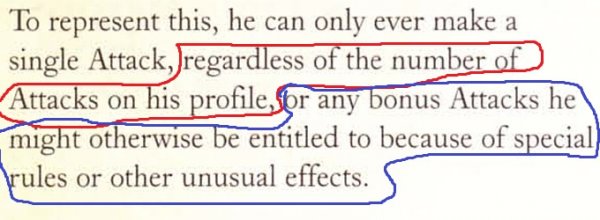
 ) get 1 attack.
02) 9829 6111


 ). He hits, wounds and then is allowed to attack again by his special rule. He followed the rules of 'Supporting Attacks' and only made a single attack, then AB > BRB, he gets to go again.