GW fluff writers have a love/hate relationship and often contradict each other. One writer was like "Tyranids killed most of them by destroying their homeworlds" then another was like "no, no, no, they were on a couple planets that weren't destroyed by Tyranids".
I don't think that's contradictory at all. That just meant there might have been 100 planets where they were based and now there are only a handful of planets left.
Regardless you can still conjure up a few units of Ratling Snipers in a 40K game by either saying they were already attached to the current regiment or they recruited like 1000 of them recently, out of a planet's population of millions?
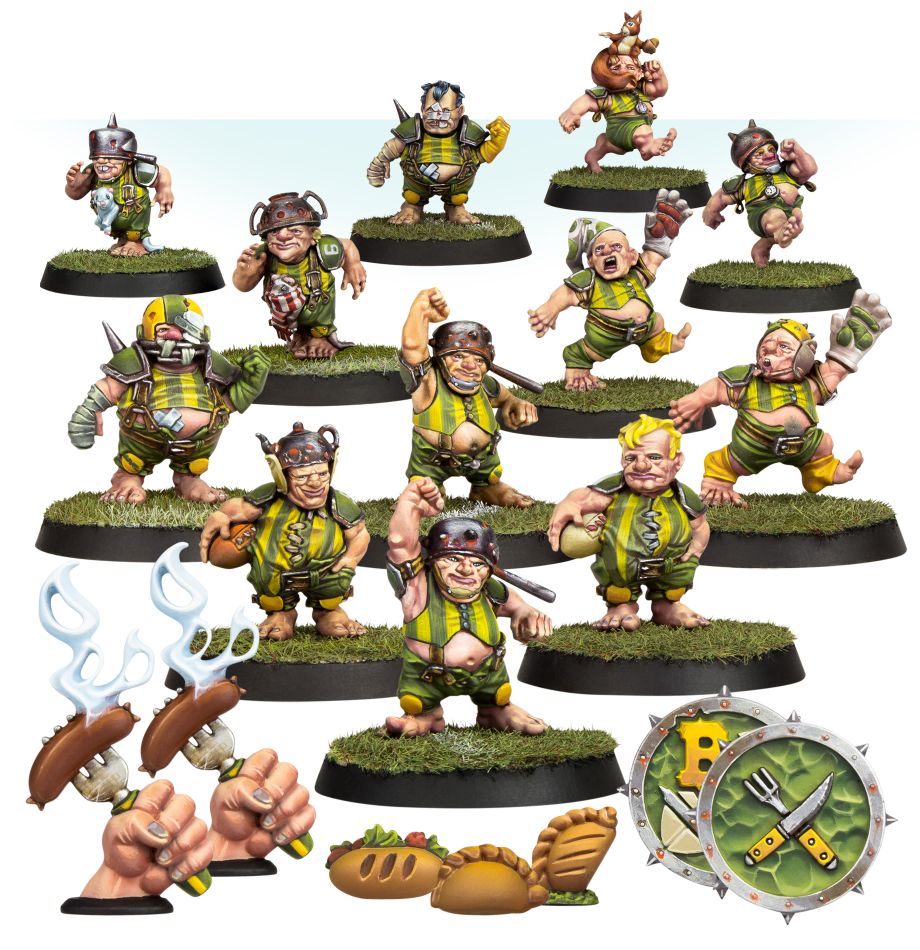
In fantasy, halflings seem largely ignored.
Haflings don't get much screentime in
Battles, because, well, they are basically Goblins to the Empire, and the Empire has really not much of a niche for it.
But they are featured prominently in
Roleplay, as they make for great thieves. Depending on the viewpoint, Halflings are consider kleptomaniacs by most and prosecuted on-and-off outside of the Moot because of it, but it's really because they have a very weak concept of private property. The lore reason (which is probably in 2nd Sigmar's Heirs but most likely been expanded in Cubicle 7's 4th edition books, can remember) is that, due to the very close kinships of the Halflings -- essentially, everyone is everyone else's cousin's cousin's cousin -- that properties within their hearth are seen as shared. The foodies therefore have no inhibition outside of their land to take what's others.
The Halflings are somewhat hobbit-like, in so far as the "simple folks of the idylic countryside" is concerned. Though they are depicted to be more ugly in many editions -- closer to village idiots in many instances. It's rare in
Roleplay to find a Halfling that's objectively evil, however -- I don't think there's even a priest of Ranald (which is basically just a thief) that's a halfling in all 4 editions!
The one instance that shows some objectively sinister shit going on in the Moot is from
Sigmar's Heirs, on page 61 where a Halfling named Dagobert brought back some sort of fertility deity back from his travels in Kislev, with which he had turned his entire village (Gipfel) to its worship. The diety demands blood sacrifice, and the halflings often kidnap travellers for this purpose.
Other than that, it's mostly inter-family struggles, for land, for some kind of ancestral rights.
Dwarfs are resistant to Chaos (but not immune), however only the blessings of Chaos/Hashut allows them to wield magic (though not without consequences!).
Curious, in lore, how tall are Halflings in comparison to Dwarfs?
Nothing is immune to Chaos. In
Battles, the Elves are marred by Chaos, just that their corruption is spiritual (8th edition, P7), and bar the Chaos Dwarfs, there was also a Slaaneshi Dwarf cult in Karak Azgal post Storm of Chaos in 2nd edition WFRP (Karak Agzal, p93).
The Halflings, as previously stated, are not immune to evil, but as for how resistent they are, I cannot say. Overall, I recall from somewhere they are just too simple to draw the Chaos Gods' gaze. They are notably immune to the influence of the Warpstone.
Unlike Dwarfs, Halflings are naturally intuned to magic, although most are petty magics and related to hearth and field. I get the impression they are about as magically inclined as normal humans.
In the 6-8 edition
Battles, it was said that Halflings and Ogres were created near the end of the Old One's reign for some unknown purposes.
I can't recall where but some in-universe scholar suggested that Ogres were resistant in flesh while the Halflings in spirit (Chaos is a spiritual corruption, after all), and the strength of the Ogres and the cunning of the Halflings were meant to compliment each other. I can't help but see a sort of mirror to the Skink-Kroxigor relationship of the Lizardmen in this. The Dwarfs were too stubborn, and the Elves too easily swayed due to how heightened their senses are, and the Ogre-Halflings were probably an attempt to create a sort of comprise between the two by giving them simpler minds.
The Gnomes, on the other hand...