• The forum software have been upgraded to the latest version.

    If you notice anything that looks off, or does not work, please let us know.

    For more information, click here.

Star Trek vs. Star Wars (and a collection of memes)

Star Trek or Star Wars; which do you like better?

  • Star Trek

    Votes: 19 23.8%
  • Star Wars

    Votes: 61 76.3%

  • Total voters
    80
494448707_10232388820517832_1307808636043441463_n.jpg
 
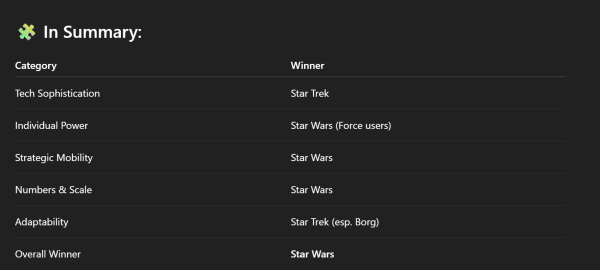
Star Wars versus Star Trek according to ChatGPT. Combined forces (good and evil working together), all Star Trek forces during TNG era vs all of Star Wars forces during OT trilogy era. No Q or other omnipotent beings...


⚔️ Basic Setup & Conditions
  • All forces from Star Trek: The Next Generation era (approx. 2360s–2370s): Federation, Klingons, Romulans, Cardassians, Dominion (including Jem’Hadar & Founders), Borg, and more.

  • All forces from Star Wars (Legends + Canon): Galactic Empire, Rebellion/New Republic, Separatists, Republic, Sith, Jedi, etc.

  • No Q or other omnipotent entities.

  • Full-scale space war, not a duel. No diplomacy. War to the finish.
Tech Comparison: Firepower & Defense
Star Wars
  • Weapons: Turbolasers, ion cannons, superweapons like the Death Star, Sun Crusher (Legends).

  • Scale: Massive ships (e.g. Executor-class ~19 km), galactic-spanning fleets.

  • Fighters: Fast, versatile (X-Wings, TIEs), but not shielded (usually).

  • Hyperspace: Near-instant travel between systems. No need for star gates or beacons.

  • Shields: Strong, but often overwhelmed by sustained barrages.
Star Trek (TNG)
  • Weapons: Phasers, photon/quantum torpedoes. Borg cutting beams and transphasic torpedoes (later).

  • Scale: Smaller ships (~600m for Galaxy-class, ~3km for Borg cubes).

  • Defenses: Shields, structural integrity fields, regenerative hulls (Borg), ablative armor (Voyager era).

  • Transporters: Can beam through shields (sometimes), remove crew or detonate bombs.

  • Warp Drive: Slower than hyperspace, more tactical than strategic.
Tactics & AI
  • Star Wars: Tactics are often WW2-style dogfights or fleet engagements. Admirals like Thrawn offer brilliant strategy. Droid armies add numbers but limited adaptability.

  • Star Trek: Heavy on technobabble solutions and clever use of science. Borg adapt to attacks quickly. Starfleet captains often rely on lateral thinking rather than brute force.
Special Factions
Star Wars
  • Force Users: Very powerful individually (telekinesis, precognition, battle meditation). Can sway battles or crush small units, but less useful in space-scale warfare.

  • Superweapons: Death Star destroys planets. Sun Crusher (Legends) destroys stars. Centerpoint Station can move celestial bodies.
Star Trek
  • The Borg: Adaptive, regenerative, collective. Can assimilate tech and even entire species. Difficult to stop without specific countermeasures.

  • Dominion: Genetically engineered soldiers and shapeshifter infiltrators. Potent but less overwhelming in a space context.
Scale: The Real Decider
This is key.

  • Star Wars has millions of worlds under its galactic empire.

  • Star Trek has a smaller, more localized quadrant-based setting. The Federation is ~150 planets.

  • Star Wars fields hundreds of thousands of star destroyers and planetary forces. Star Trek fleets are usually dozens to hundreds of ships.
In pure scale, Star Wars utterly dwarfs Star Trek.

Verdict
Winner: Star Wars
Why:

  • Numerical superiority: Thousands of fleets vs. hundreds of ships.

  • Hyperspace mobility: Can blitz Star Trek space before they even reposition.

  • Superweapons: The Death Star, Centerpoint, and Sun Crusher (if included) tilt the board hard.

  • Overwhelming scale: They simply bring too many ships, too many systems, and too much firepower.
Caveats:
  • The Borg are Star Trek’s best hope. If they can rapidly assimilate Star Wars tech or Force-sensitive species, they could change the game. But speed is the issue — Star Wars can bring force to bear faster than the Borg can adapt.

  • If you remove Legends (e.g. no Sun Crusher), the margin narrows but Star Wars still wins on size and logistics.
upload_2025-6-3_0-51-42.png
 
I think Star Wars factions would beat equivalent Star Trek factions, but they have to win Russian style, with piles and piles of their own dead. I imagine one Star Trek warship would be be worth dozens of Star Wars warships.

Star Trek space weapons almost never miss. Star Wars weapons go quantity over quality, very spray and pray.

A Romulan/Cardassian alliance had about two dozen ships. They had the fire power to hypothetically render a planet uninhabitable to life with a one hour bombardment. No Death Star required.

In Star Trek terms, two dozen warships is a mighty fleet. In Star Wars, two dozen warships is a ragtag force.


Shields on an X-wing or Y-wing wouldn't matter much. Star Trek ships can one-shot any fighter. So you might as well launch a bunch of TIE-fighters.

That's why they hardly ever use fighters except in extremely important military engagements. Star Trek fighters can sometimes dodge enemy fire, but it's still the most dangerous assignment you can get in Starfleet.


If there was a long and drawn out war, I believe Star Wars and Star Trek would merge tactics. The Star Wars groups would gradually implement Star Trek style weapons and the Star Trek groups would gradually build mass fleets.

Hypothetically, if the Star Wars people captured a relatively intact ship, they could reverse engineer the better weapons and shields.

If the Star Trek factions were pushed in a war of attrition, they would stop coddling 99% of their civilians and institute some form of a military draft and also start mass producing ships.

 
Last edited:
Back
Top