All this quoted material is from the brainstorming thread. I will sift through it paragraph by paragraph to Catalog the bits where
@Lord Agragax of Lunaxoatl causes me to think, “Errrrr, what? wait, No...”
I’ll try to ignore
most Warhammer universe aspects.
What I think I know about Warhammer-Albion is from the Albion campaign from the 5th or 6th edition of Warhammer when White Dwarf magazine was in the range of issues 259-268.
Settlers From Albion
...settlers from Albion arriving many year before all the other races when the Empire was causing trouble and invading everyone else, and being an already-established culture by the time all the other races travel over to the new world. I noticed that you forgot to include Albion in your lore, and thought it would be great to do an alternative take on the real-world event of the Vikings first discovering America many hundreds of years before Columbus, by changing it so that it was actually the Celtic-style peoples of Albion who got there first (the Norse being allied with Chaos and too busy fighting the Empire at the time to notice).
I contend that the human population of Warhammer-Albion (as written by GW) was primarily a bunch of primitives that made the Picts look clever and educated.
There were Giants, there were a tiny number of spellcasters (Truthsayers or Emissaries) and a bunch of wretched, cave dwelling mooks.
Of course this is fantasy, so we could say that somehow the tribes of Albion were able to start working on their own large transport ships to take their people across the huge expanse of sea (maybe the Druids and Truthsayers predicted that there was a 'land of bounty' across the wide wide sea and some of the warriors and their families agree to sail over and investigate), and first landed while the Empire was expanding across the Old World. Of course the Empire aren't going to take much notice of Albion because it is small, seemingly insignificant compared to Bretonnia, Estalia and Tilea, and the people there generally kept themselves to themselves.
We agreed ^ that kindly Elves and Stone circles are a simpler explanation.
Anyway, just as the Vikings in the real world did, the people of Albion encounter the natives when they first settle in the New World, but again I plan to include a difference in events. In the real world, the Vikings had superior weaponry but were ousted by the natives due to a combination of having far fewer people and no obvious ways to protect their settlements, but in the Warhammer version the people of Albion are able to construct a hillfort which is far better defended and are able to secure a permanent settlement in the New World, despite the attempts made by the natives to destroy them.
The Vikings were ousted because
they were massively outnumbered. Hill Forts need a huge construction force and numerous defenders. It was all down to numbers. I would call that partial agreement.
Viking settlements in the new world were too small to even try a Hill Fort and they were in places where there was little timber for palisades. So I’m disagreeing about the relevance of Hill Forts.
If we look at their real-world Celtic counterparts, we know that the Celts fought each other as much as foreign powers - indeed, warfare was an integral part of Celtic culture. However, one benefit of regularly fighting the neighbours was that necessity demanded that the Celts build their settlements in places that could allow them to be made more resistant to enemy attacks. These hillforts became more and more well defended so that, at the peak of the Celts' power, hillforts were practically impregnable to infantry and cavalry attack - they were the stone castles of their day. Networks of trenches, ditches and earthworks were built so that they would not only slow down an approaching enemy force, but they could also be used to funnel them into just a few places where Celtic defenders could shower them with missiles.
That paragraph is all speculation. Neither of us was alive then, so we don’t really how Hill Forts worked.
They were the
earthwork Forts of their day... ...rather than Castles. Castles are smaller.
Indeed hillforts were designed with only one, maximum two or three, gateways, the earthworks around which were purposefully designed to funnel enemies into going that way. Many of these gateways were also supported by ramparts and palisade either side of the main gateway, so that all enemies funnelled into the gateway would be attacked on three sides,...
Or the elaborate gates and multi-layered ramparts had other purposes.
Like controlling the movement of people and livestock on market days maybe.
While hillforts were easily conquered by the Romans, they were only able to do so by using siege engines, which of course they had pioneered during their many conflicts with other nations. The Celts on the other hand had no experience in siege warfare (mainly because they had no interest in practicing it - it was seen as dishonourable to stand back and fire a big catapult or hide in a siege tower when you could be hurling yourself into the thick of it like a true warrior) and so their hillforts were designed exclusively to counter warbands of infantry and cavalry (which was how the Celts fought each other in tribal raids), a job they did perfectly.
If the Celts had no experience with sieges why did they fortify? The whole point of building a fortification is to leave your opponent with no other option but to besiege you. If they had Forts and they warred with each other they had sieges.
The Romans were simply better at assaulting fortifications.
NB: ...
siege means surround and isolate an enemy who is Forted up.
Assault is the word for smash into the enemy fort.
Siege Warfare entails starving out the Foe or vanquishing an Invader by waiting them out. The Romans didn’t have time for that.
Coincidentally, the preferred fighting style of the Native Americans was also using their large bands of warriors to launch lightning assaults on the enemy, which means then that the hillfort is a devastating counter to the Native Americans' battle tactics, if we're now assuming that we're putting Celts from this world into America in the same time period. Sure, the Native Americans can use their familiarity with their homeland to ambush and slay Celtic war parties, but they would have had absolutely no hope of being able to shift the Celts from their hillforts unless several entire tribes united to launch an attack on one hillfort, and even then there would be a huge number of casualties for the Native Americans.
I don’t think having Hill Forts means automatic superiority for those who are forted up. Without enough numbers to defend its perimeter it is useless.
Therefore, as opposed to the Vikings whose settlements were relatively unprotected, the Celts, and indeed the peoples of Albion, would have been able to construct settlements to ensure that they were here to stay. [...snip Warhammer stuff... ]
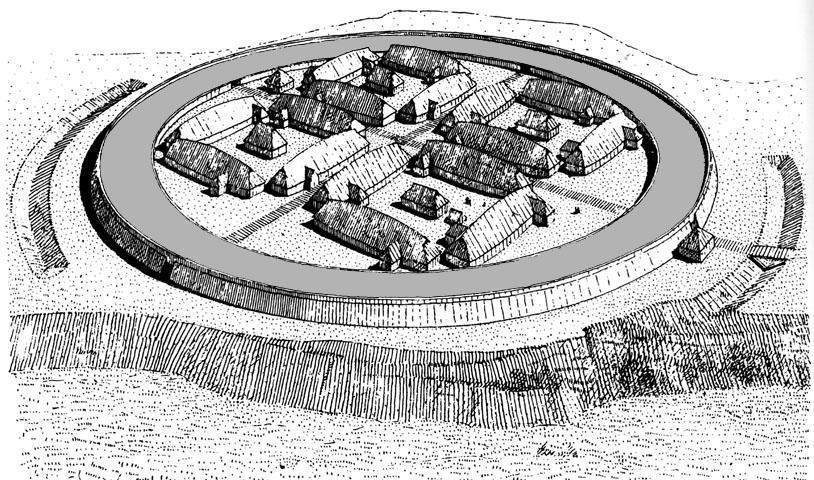
Disagree. The Vikings did build places fortified with earthen ramparts. There is an example in Denmark.