
Slann
NIGHTBRINGER
Second Spawning
- Messages
- 90,758
- Likes Received
- 278,747
- Trophy Points
- 113
After a bit of a delay, we finally have our next matchup. The undefeated Witch Elves take on the Beasts of Nurgle.
Key rules in play:
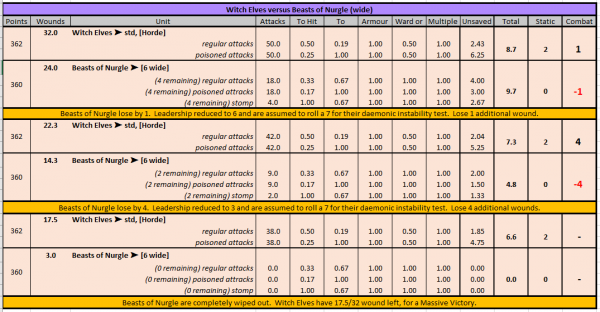
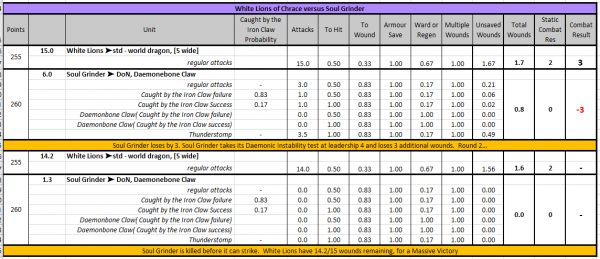
This was a very strange matchup and I had to run alternate unit formations until I got a clear representation of how the two sides matched up. Originally I had the Beasts of Nurgle formed up 6 wide. This ended disastrously for the Beasts of Nurgle, with the Witch Elves actually claiming a Massive Victory. For those interested, you can find those calculations here:
So in one scenario the Beasts pull off a Victory and in another formation the Witch Elves get a Massive victory. So the logical question would be to ask me how I choose which scenario counts and which scenario does not? I've add a detailed description of how I make such decisions to the original post of this thread. You'll find it under the heading: "How unit formations are selected/considered".
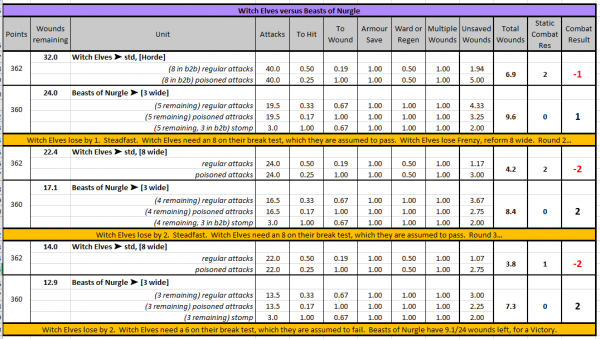
In short, I take on the viewpoint of each side, as if I were the general of that unit in this tournament. Running a couple of alternate scenarios, it was found that the optimal formation for the Beasts was 3-wide. Meaning, that the Beasts of Nurgle player is content fielding the unit in a 3x2 formation, no matter what formation the Witch Elves player decides to field. I then ran multiple Witch Elves formations [5 wide, 6 wide, 8 wide and horde] in the first round of combat, but there was no way for them to counter the Beasts in their 3x2 formation. It turned out that the Horde option remained the best for them, so that is how we arrived at the 3x2 vs. horde scenario. So if I were playing against myself, then mathematically, the Beasts of Nurgle fielding version of myself would win, no matter how the Witch Elves version decided to field his unit.
Okay, so why did formation change make such a difference? The Beasts changing formation to go narrower (3x2, instead of 6x1), deprived the Witch Elves of 10 of their attacks (as only 8 were in base to base contact). This meant that the Beasts were able to get through the Witches' opening round of attacks with 5 models remaining (with one sitting on a single wound), as opposed to 4. This meant that their output remained largely unchanged because the loss of attacks from the back (3 vs. 4.5 from the front rank + stomp) was offset by having an additional model to attack with, but the Witch Elves' output was more severely affected. In terms of the outcome, the first round of combat swung from the Witch Elves winning by 1, to the Beasts of Nurgle winning by 1. This was extremely significant, because it meant that the Witch Elves lost their frenzy. This small change in the first round had a cascading effect on the final result. Similar to the Hammers vs. White Lions matchup, this matchup is extremely fragile. Very small changes round-to-round can completely change the result. In the end, there was no Witch Elf formation I could find to get them to win combat (and retain their all important frenzy) in the first round when facing the Beasts in a 3x2 formation.
This also highlights a key advantage of multi-wound models. Their offensive output is not tied to singular wounds sustained. The Beasts only lose combat effectiveness for every 4 wounds they sustain.
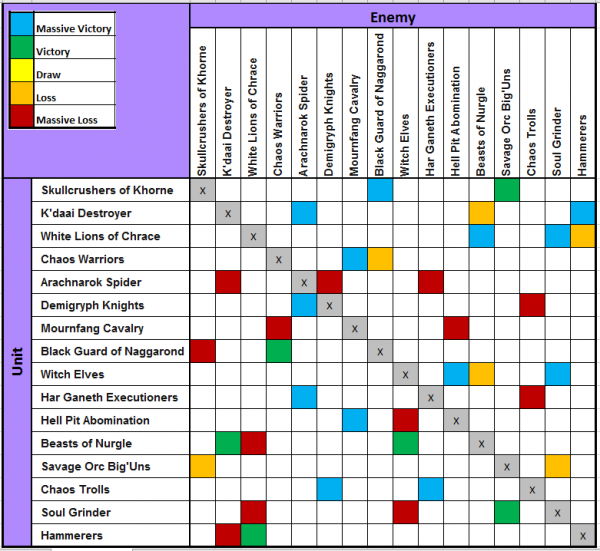
Anyways, with all that babble out of the way, here is our updated chart:
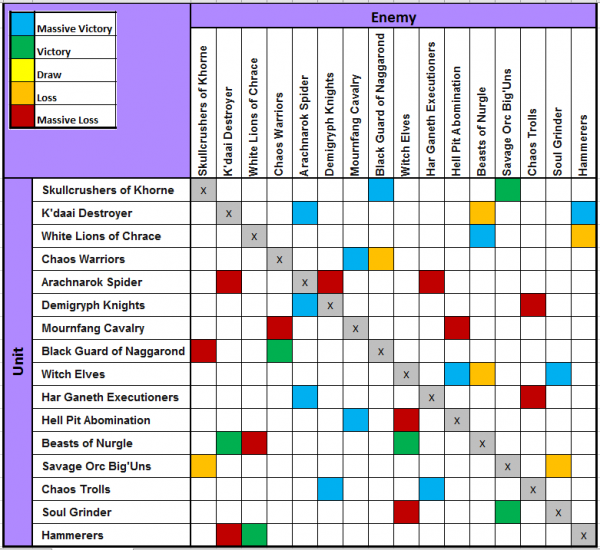
So the Witch Elves are no longer undefeated, can the Troll's claim the top spot? As for the Beasts of Nurgle, they should not be underestimated. So far they have two victories against two extremely potent units (K'daai Destroyer and Witch Elves) and their sole loss (albeit a massive one) came at the hands of their only hard counter in our tournament, the Banner of the World Dragon wielding White Lions.
And as always... Thoughts? Concerns? Discussion!!
Key rules in play:
- Witch Elves: ASF, Frenzy, Murderous Prowess, Poisoned Attacks
- Beasts of Nurgle: Deamon of Nurgle, Daemonic, Poisoned Attacks, Random Attacks (D6+1), Regeneration
This was a very strange matchup and I had to run alternate unit formations until I got a clear representation of how the two sides matched up. Originally I had the Beasts of Nurgle formed up 6 wide. This ended disastrously for the Beasts of Nurgle, with the Witch Elves actually claiming a Massive Victory. For those interested, you can find those calculations here:
So in one scenario the Beasts pull off a Victory and in another formation the Witch Elves get a Massive victory. So the logical question would be to ask me how I choose which scenario counts and which scenario does not? I've add a detailed description of how I make such decisions to the original post of this thread. You'll find it under the heading: "How unit formations are selected/considered".
In short, I take on the viewpoint of each side, as if I were the general of that unit in this tournament. Running a couple of alternate scenarios, it was found that the optimal formation for the Beasts was 3-wide. Meaning, that the Beasts of Nurgle player is content fielding the unit in a 3x2 formation, no matter what formation the Witch Elves player decides to field. I then ran multiple Witch Elves formations [5 wide, 6 wide, 8 wide and horde] in the first round of combat, but there was no way for them to counter the Beasts in their 3x2 formation. It turned out that the Horde option remained the best for them, so that is how we arrived at the 3x2 vs. horde scenario. So if I were playing against myself, then mathematically, the Beasts of Nurgle fielding version of myself would win, no matter how the Witch Elves version decided to field his unit.
Okay, so why did formation change make such a difference? The Beasts changing formation to go narrower (3x2, instead of 6x1), deprived the Witch Elves of 10 of their attacks (as only 8 were in base to base contact). This meant that the Beasts were able to get through the Witches' opening round of attacks with 5 models remaining (with one sitting on a single wound), as opposed to 4. This meant that their output remained largely unchanged because the loss of attacks from the back (3 vs. 4.5 from the front rank + stomp) was offset by having an additional model to attack with, but the Witch Elves' output was more severely affected. In terms of the outcome, the first round of combat swung from the Witch Elves winning by 1, to the Beasts of Nurgle winning by 1. This was extremely significant, because it meant that the Witch Elves lost their frenzy. This small change in the first round had a cascading effect on the final result. Similar to the Hammers vs. White Lions matchup, this matchup is extremely fragile. Very small changes round-to-round can completely change the result. In the end, there was no Witch Elf formation I could find to get them to win combat (and retain their all important frenzy) in the first round when facing the Beasts in a 3x2 formation.
This also highlights a key advantage of multi-wound models. Their offensive output is not tied to singular wounds sustained. The Beasts only lose combat effectiveness for every 4 wounds they sustain.
Anyways, with all that babble out of the way, here is our updated chart:
So the Witch Elves are no longer undefeated, can the Troll's claim the top spot? As for the Beasts of Nurgle, they should not be underestimated. So far they have two victories against two extremely potent units (K'daai Destroyer and Witch Elves) and their sole loss (albeit a massive one) came at the hands of their only hard counter in our tournament, the Banner of the World Dragon wielding White Lions.
And as always... Thoughts? Concerns? Discussion!!



 ) so I have to read in on all the battles since Monday.
 too late for it now, but it would be interesting to see what other apex-builds exist for any of the combatants we have had so far.
